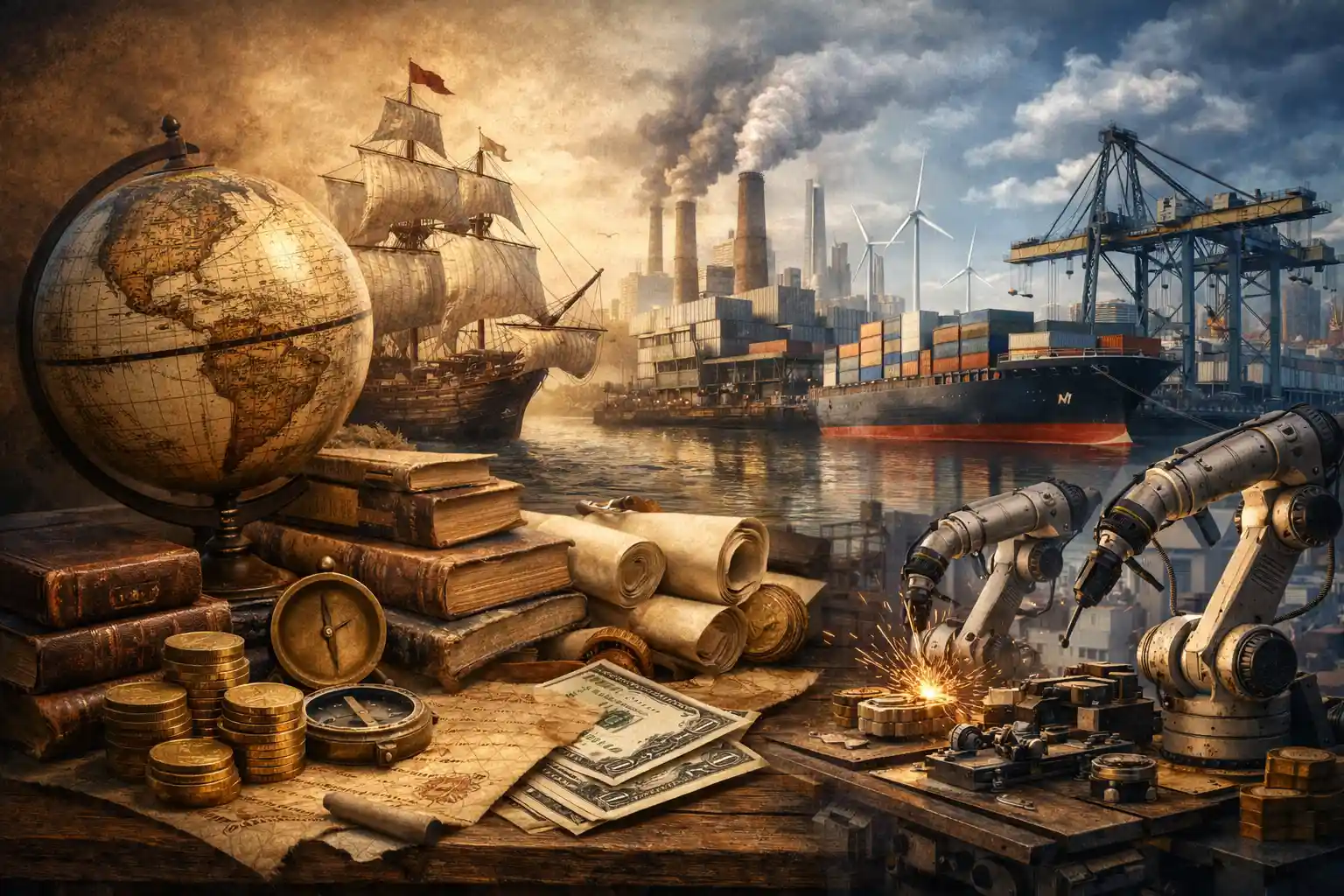
In the post-Cold War decades, globalisation developed along a distinctly liberal economic logic. The US-led multilateral trade regime was conceived essentially as a framework under which open markets, comparative advantage, and multilateral trade would lead to prosperity and stability. Production networks extended beyond borders, but this process was driven by cost efficiency and market rationalisation, not strategic government direction.
The advanced economies also gradually withdrew from explicit industrial planning, trusting in global value chains and private capital to direct resources efficiently. Trade policy was being stripped of politics, placed within institutional frameworks that stressed integration rather than sovereignty.
But this liberal economic order has repeatedly had its durability tested. The global financial crisis, pandemic-induced disruption in supply chains, and a renewed contest in geopolitics, especially in technology and critical industries, have exposed fault lines in hyper-integrated markets. Governments that long preached ‘small government’ are now directly subsidising strategic industries, intensifying investment screening processes, and framing trade policy in national security terms.
Global trade is now not only about being efficient but about being resilient and strategically autonomous. This new alignment between economic policy and state power raises a basic question: is the renewed military-industrial complex a throwback to mercantilism, or is it strategic insurance in a globalised but interdependent world?
The Mercantilist Foundations of Economic Strategy
Between the 16th and 18th centuries, mercantilism was the predominant economic thought in Europe, and where commerce was seen not as a free market activity of the state but as a tool of state power. Trade policy was intentionally crafted to serve national interests, and economic strength was a precondition for geographical power. It was a basic presumption that wealth and power were intimately related and that states need to intervene in the economy in order to maintain their political power.
Governments thus encouraged exports, limited imports, and shielded industries deemed crucial to national security and sovereignty. Accumulation of wealth, usually defined in terms of bullion reserves and positive trade balances, was connected to the ability to fund military expansion and maintain political hegemony. Markets were not conceptualised as neutral spaces governed simply by efficiency; they were understood as embedded within broader strategic ends. Economic policy was inextricable from the matter of politics of state and competition.
Classical mercantilism fell out of favour with the ascendance of liberal economics and its focus on comparative advantage, but the logic underpinning it was not totally obliterated. The long-standing equation of economic capability with political power continues to shape state behaviour. It is this continuity of connection, which makes the mercantilist perspective useful in analysing the current resurgence of industrial policy.
The Revival of Industrial Policy in the Twenty-First Century
Over the past few years, industrial policy has once again become an important instrument of economic governance among the world’s largest economies. The governments that espoused market-led globalisation are now pivoting towards strategic industries – semiconductors, renewable energy, defence technology and critical minerals. Massive subsidies, export controls, and investment screening mechanisms have proliferated, frequently based on national security and economic resilience rather than pure efficiency rationale.
This realignment has been conditioned by a sequence of structural dislocations. The global financial crisis revealed the vulnerabilities of liberal economic integration, and the COVID-19 pandemic highlighted the vulnerabilities of highly centralised supply chains. Semiconductor shortages, energy shocks and intensifying technological competition – especially between great powers – have compounded worries about economic susceptibility. The states themselves subsequently have sought ways to insulate themselves from the outside world and reestablish control over critical production networks.
What defines this moment is not exit from global trade, but a reorientation of its principles. Efficiency is no more the only organising logic for international commerce. On the contrary, resilience, strategic autonomy and technology leadership have been more emphasised. Economic policy is increasingly being influenced by wider geopolitical rivalry, heralding a return to a rapprochement between market and state models.
Neo-Mercantilism or Strategic Reconfiguration?
The modern resurgence of industrial policy is strikingly similar to mercantilist thought. Trade again became a matter of national power, and strategic industries, especially technology, energy and critical minerals, were protected and subsidised in the name of sovereignty. Governments are becoming more prone to skew markets in their favour in order to achieve technological superiority and minimise external reliance. Export and investment controls also reflect an emerging understanding that economic integration can be a source of vulnerability as much as it is a source of prosperity. So, in a way, economic policy is being re-embedded in broader geo-political competition.
But the present situation is very different from the classic mercantilism then. The volume of world trade is still large, cross-border supply chains are still functioning, and multilateral institutions still shape the economic game. States are not attempting autarky, or a full exit from global markets. What they are doing is taking a more selective approach to recalibrating interdependence. Strategic sectors are favoured, while general economic exchange continues. This is not to say that globalisation is being discarded wholesale, but that the terms of engagement are being restructured.
Instead of signifying a revival of mercantilism as it was traditionally practiced, today’s turn might be more accurately described as a stage of strategic globalisation. Interdependence has not vanished; it is being managed. Trade policy is no longer governed solely by the principle of efficiency, now, resilience and security are also given space. In this developing system, economic statecraft has come to the fore, in a world in which markets and power are once more intimately linked.
Conclusion
The revival of industrial policy is not a sign of globalisation collapsing but of globalisation evolving strategically. We live in an era of “security”, “resilience”, and “technological competition” which centre towards economic integration. Rather than fighting for interdependence, states are lining their pockets with more selective management of it and more control of critical sectors even as they engage more broadly in global markets. In this new world, economic statecraft is not in the periphery but at the heart of geo-strategic thinking.
The question is no longer simply free trade versus protectionism, but also efficiency versus strategic autonomy. For middle powers trying to make the transition, the challenge will be to find the right combination of integration and sovereignty. When it comes to trading, much of the mercantile influence remains relevant even if reshaped as illustrated by the present moment.
All the views and opinions expressed are those of the author. Featured Image is subjected copyright by The Viyug.
About the Author

Archita Gaur is a postgraduate student at the School of International Studies, Jawaharlal Nehru University (JNU). She specialises in the world economy and has a strong interest in public policy, economic research, and governance.

2 thoughts on “Is Modern Industrial Policy a Return to Mercantilism?”