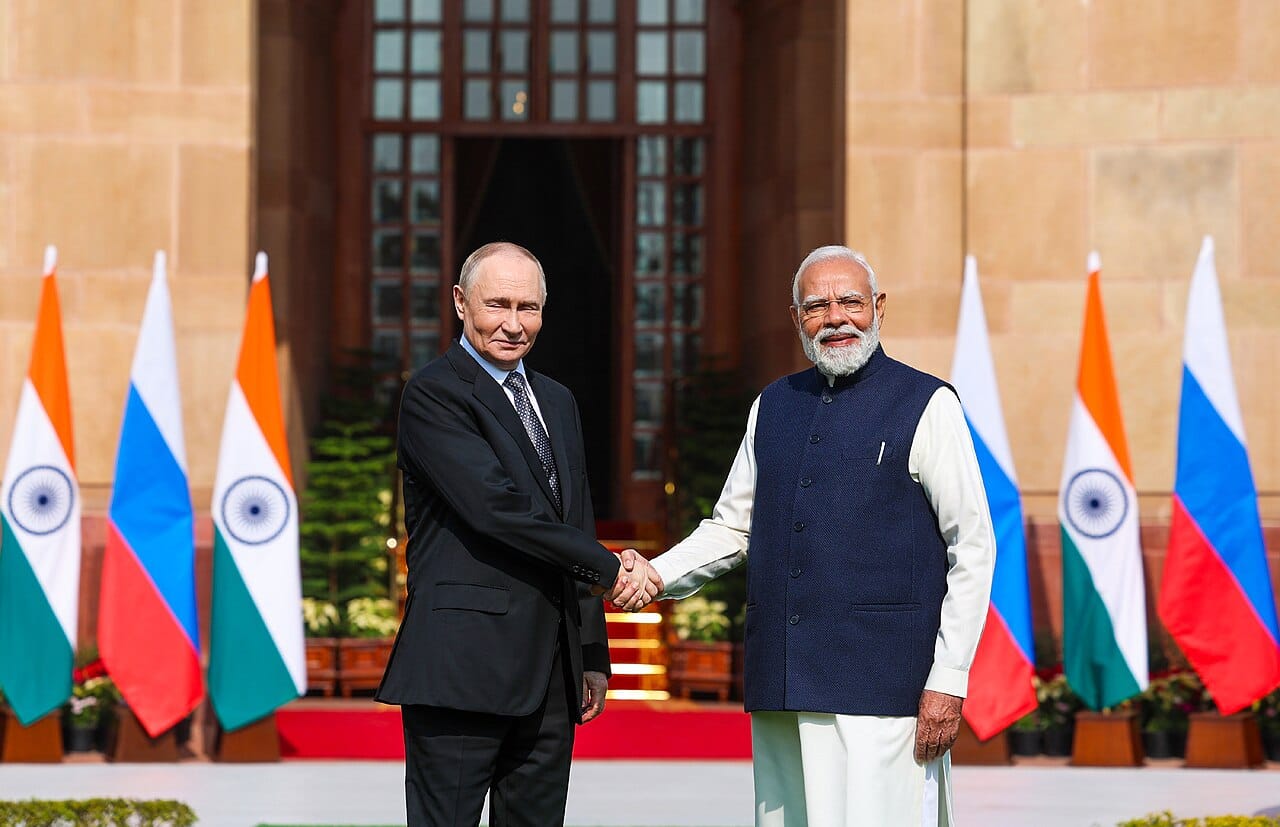
The recent two-day visit of Russian President Vladimir Putin to India, culminating in a joint media briefing with Prime Minister Narendra Modi in Delhi, underscored the enduring strength of the India-Russia strategic partnership. This high-profile summit, held against the volatile backdrop of the Ukraine conflict and mounting Western pressure on Delhi, served as a powerful testament to the multifaceted cooperation between the two nations, particularly in energy, trade and defence.
The most salient and immediate takeaway from the summit was Russia’s unequivocal pledge to maintain “uninterrupted shipments”of fuel to India. This commitment comes at a crucial time when India is facing an additional 25% tariff from the US, levied by the Donald Trump administration specifically over Delhi’s continued purchase of discounted Russian oil. This tariff, which brought the total US levy on Indian imports to a challenging 50%, was framed by Washington as a penalty for allegedly funding Moscow’s war effort in Ukraine a charge India has repeatedly denied.
Energy Autonomy vs. Western Pressure
India, the world’s third-largest consumer of crude oil, has been a major buyer of Russian oil since the 2022 invasion of Ukraine. This surge saw Russian oil’s share of India’s imports leap from a mere 2.5% before the war to approximately 35.8% in 2024-2025.
Prime Minister Modi and his government have maintained a resolute stance of “energy autonomy,” arguing that the nation must import the cheapest available oil to protect millions of its citizens from high fuel costs. India has also pointed to the perceived hypocrisy of some Western nations, noting that the European Union continued to import Russian energy, albeit at reduced levels.
Russia’s Commitment and US Sanctions
In his address, President Putin not only promised uninterrupted fuel supply but also referenced the ongoing “flagship” project of building India’s largest nuclear power plant, a key area of bilateral civil nuclear energy cooperation.
The US sanctions, including punitive tariffs and actions against Russian refineries like Rosneft and Lukoil, have begun to show an effect, with some Indian firms, such as the conglomerate Reliance Industries, reportedly reducing or stopping their imports of Russian crude. Despite this, preliminary tracking data from Kpler indicated a slight rise in Russian oil deliveries in November, suggesting that Russian barrels continue to dominate India’s oil mix. India currently remains the largest buyer of sea borne Russian crude, highlighting the critical nature of this energy relationship.
Putin directly addressed the US penalty, questioning its rationale. He pointed out, “The United States itself still buys nuclear fuel from us for its own nuclear power plants. If the US has the right to buy our fuel, why shouldn’t India have the same privilege?” He affirmed Russia’s commitment to building a solid commercial relationship based on mutual trust, stating that energy cooperation remains “unaffected by current conditions, fleeting political swings or the tragic events in Ukraine.”
Economic Cooperation and Trade Targets
While the summit did not yield any “blockbuster” defence deals which some analysts had anticipated the core focus was firmly on boosting trade and economic ties. Both leaders hailed the signing of numerous agreements, including memorandums of understanding (MoUs) in areas like shipbuilding, agriculture, investments in civil nuclear energy, and critical minerals.
The 2030 Economic Programme
A major announcement was the agreement on an Economic Cooperation Programme lasting until 2030. President Putin expressed confidence in maintaining the current bilateral trade volume, which is already over $60 billion, and setting an ambitious goal of ramping it up to $100 billion in the coming years.
Other key trade and connectivity initiatives included:
National Currencies in Trade: Putin welcomed the increased use of national currencies for trade settlements, noting that approximately 90% of trade payments between India and Russia are now settled outside of the US dollar.
Shipping Lanes and Seafarer Training: Agreements were signed on investments in new shipping lanes and the training of Indian seafarers to operate in polar waters, signalling a joint effort to enhance maritime connectivity and access to Arctic routes.
Aviation Deal: The focus was back on the initial agreement to build the SJ-100, a Russian short-haul passenger jet, in India, indicating a commitment to collaboration in the burgeoning Indian aviation market.
The emphasis on boosting non-oil trade is vital for both countries. Russia is dealing with the economic impact of Western sanctions, and India is navigating new US tariffs. The economic programme provides a strategic roadmap for diversification, reducing reliance solely on crude oil sales, which have recently faced pressure.
Defence and Strategic Ties
Historically, defence has been the bedrock of the India-Russia relationship, a bond stretching back to the Soviet era. Despite India’s drive to diversify its arms imports and boost domestic production (the “Make in India” initiative), Russia remains a key arms supplier. President Putin characterised India as a “reliable and privileged partner” in military-technical cooperation. He highlighted a unique aspect of this partnership: “We are not simply selling technology we are sharing it,” which speaks to the high level of mutual trust.
- Key Military Assets: Russian-made equipment, such as Sukhoi-30 jets, still form the backbone of the Indian Air Force. India is also expanding its S-400 air-defence arsenal.
- Cooperation Areas: The portfolio of defence cooperation is broad, covering naval construction, rocket and missile engineering, and aircraft engineering.
For Delhi, maintaining strong Russian defence ties is a strategic balancing act. It ensures operational continuity for existing military assets and sends a powerful strategic signal of its independent foreign policy, even amidst intense Western scrutiny.
Foreign Policy and Global Order
The summit was not just about bilateral trade; it reinforced a shared vision for a “more just” and “multipolar” world order, a goal both nations pursue through platforms like the BRICS coalition (Brazil, Russia, India, China, South Africa).
Ukraine and the Stance on Peace
The Ukraine conflict was, predictably, a central point of discussion. Prime Minister Modi reiterated India’s consistent position: India is not neutral on the war but stands firmly on the “side of peace.” He stressed that the conflict must end through “dialogue and diplomacy,” welcoming all efforts for a peaceful and lasting solution and affirming India’s readiness to “contribute in the future.”
President Putin, while speaking about a “peaceful solution,” used the occasion to issue a fresh warning regarding the Donbas region. He stated that Ukraine must withdraw its troops from the Donbas region or Russia would seize it by force a comment that dominated global headlines and underlined the complexity of the ongoing peace efforts
Cultural and People-to-People Ties
To deepen the relationship beyond government and defence, both leaders announced initiatives to strengthen cultural and interpersonal bonds:
- Consulates and Visas: India has opened two new Indian consulates in Russia, and two new 30-day visa schemes will soon be available for Russian tourists visiting India.
- RT India Launch: Putin participated in the formal inauguration of the India bureau of Russia Today (RT) news network. He stated that RT’s presence would help Indians learn more about Russia by broadcasting “objective information,” a move analysts view as a strategic effort to promote the Russian perspective globally, especially after the channel’s operations were curtailed in the West.
A Relationship that has “Stood the Test of Time”
As Prime Minister Modi eloquently stated during the joint briefing, the India-Russia friendship has stood firm “like a pole star” throughout many crises. This historic relationship dates back to the Soviet era, with Moscow famously providing a strategic counter balance to Pakistan’s Western allies during the 1971 war and consistently using its veto powers at the United Nations Security Council to support India’s position on contentious issues, including Kashmir.
The warm reception for Putin in Delhi, including Modi breaking protocol to welcome him at the airport, was a clear signal to the international community: Delhi’s foreign policy and its ties with Moscow will not be dictated by pressure from the US or the West.
However, the visit also highlighted the delicate diplomatic tightrope walk for PM Modi. While his proximity to Putin strengthens a key strategic relationship, he must also be cautious that this does not come at the irreparable cost of ties with the US, a relationship that has, at times, been “unpredictable” under the Trump administration. The high tariffs levied by Washington are a tangible cost of this balanced approach.
Ultimately, the Putin-Modi summit was a powerful affirmation of a strategic partnership that, driven by mutual economic need, defence requirements, and a shared vision of a multi-polar world, continues to weather geopolitical storms. Russia needs a strong, reliable market for its resources and arms, and India needs affordable energy and critical defence supplies. The agreements signed lay the groundwork for a deepening relationship, anchored by the 2030 Economic Cooperation Programme and Moscow’s explicit commitment to “uninterrupted” fuel supply.
All the views and opinions expressed are those of the author. Image Credit: Prime Minister’s Office.
About the Author
Harshit Tokas holds a Master’s degree in Political Science from the Indira Gandhi National Open University (IGNOU). He completed Bachelor’s degree in Political Science from Amity University.