On 1 March 2026, Prime Minister Christopher Luxon and Foreign Minister Winston Peters issued a joint statement addressing the American and Israeli strikes on Iran. Their response was carefully calibrated. They neither endorsed the attacks nor openly opposed them. Instead, they noted that New Zealand recognised the operations as intended to prevent Iran from continuing to pose a threat to international peace and security. The phrasing felt notably restrained, almost to the point of detachment.
While the statement strongly condemned Iran’s retaliatory missile strikes and called for the protection of civilians alongside a return to diplomatic negotiations, it offered only that minimal acknowledgment when it came to the initial military action. The effect was stark. A country that once prided itself on clarity and conviction in foreign policy appeared to retreat into ambiguity. The contrast between New Zealand’s self-conception and its actual response defines the episode.
New Zealand’s history includes decisions that imposed tangible costs but affirmed a distinct national stance. In 1984, the government enacted the Nuclear Free Zone Act, refusing entry to nuclear-armed American vessels. The United States responded by downgrading bilateral relations and limiting intelligence cooperation. The consequences were immediate and significant, affecting both security ties and economic interests. Even so, the policy endured. In 2003, under Prime Minister Helen Clark, New Zealand declined to participate in the invasion of Iraq despite sustained pressure from key allies.
That decision carried diplomatic repercussions and reduced influence in Washington, yet it reflected a consistent adherence to principle. These choices were grounded in three enduring elements: a commitment to the rules-based international order, a deliberate distance from great-power conflicts, and an emphasis on Pacific-focused multilateralism where influence could be exercised through diplomacy rather than force. At the time, both the public and political leadership accepted the trade-offs inherent in such positions. That willingness to prioritise principle over expediency now appears diminished.
The response to the Iran strikes illustrates how much that capacity has eroded. The joint statement from Luxon and Peters established a tone of cautious neutrality. It acknowledged the US-Israeli operation without offering explicit support and shifted attention quickly to Iran’s subsequent escalation. During a press conference the following day, Luxon was pressed on whether the strikes complied with the United Nations Charter. He declined to provide a judgment, stating that the legal justification rested with the countries that carried out the operation and noting that New Zealand lacked access to their intelligence assessments.
When asked about reports of a strike on a girls’ primary school in Minab that allegedly resulted in over 150 child fatalities, he again avoided direct comment, citing incomplete information. His remarks on civilian protection remained general and noncommittal. He emphasised New Zealand’s longstanding opposition to Iran’s nuclear ambitions, its alleged support for militant groups, and its domestic repression, though he later clarified that he had misspoken when his comments appeared to suggest broader approval of military action.
In practical terms, New Zealand’s position aligned more closely with uncritical acknowledgment than with the measured reservations expressed by countries such as France, Germany, and the United Kingdom. Those governments at least signalled concern and emphasised de-escalation. New Zealand did not, despite lacking the strategic leverage that might justify such caution. The result was a stance that conveyed deference rather than deliberate judgment.
Opposition parties did little to sharpen the debate. Labour leader Chris Hipkins called for restraint and stated that his party did not support the strikes, yet his remarks focused primarily on the need for renewed diplomacy rather than a sustained critique of their legality. Former Prime Minister Helen Clark was more direct, describing the government’s response as unacceptable and asserting that the strikes violated international law while negotiations were still ongoing. However, she spoke in a personal capacity rather than as a policymaker.
The Green Party condemned the attacks as unlawful and unjustified, but its earlier participation in coalition governments had coincided with deeper security cooperation with the United States and expanded military engagement in the Pacific. This inconsistency weakened the force of its criticism. Across the political spectrum, no actor mounted a sustained defence of New Zealand’s traditional independent posture. The absence of a deeper, principled debate suggested a broader reluctance to confront the underlying question of whether such independence remains viable.
Several structural factors help explain this shift. Luxon has explicitly framed his foreign policy approach around positioning New Zealand as a dependable partner to its traditional allies. This orientation limits the scope for dissent once those allies have acted. Alignment becomes the default rather than a choice. Economic considerations further constrain policy. Under the current United States administration, trade measures such as tariffs have been used as tools of influence, raising the potential costs of divergence.
Unlike in 2003, when the consequences of independence were largely diplomatic, present-day decisions carry immediate economic implications for key sectors such as agriculture and tourism. A third factor lies in institutional capacity. New Zealand lacks a robust, independent foreign policy research sector comparable to institutions in countries like Australia. Without well-resourced, nonpartisan analysis to inform decision-making, policy is shaped within a relatively narrow circle of officials and ministers, often under the pressure of immediate alliance considerations. This limits the ability to develop and sustain alternative strategic perspectives.
The contrast with 1984 is instructive. At that time, New Zealand accepted significant strategic and economic costs in order to uphold a clear principle. Intelligence ties weakened, diplomatic relationships cooled, and practical inconveniences accumulated. Nevertheless, the government proceeded because it retained confidence in its own judgment and in public support for the decision. That confidence now appears less certain.
The central issue is no longer whether New Zealand should have taken a different position on the Iran strikes. Rather, it is whether the country still possesses the institutional strength and intellectual independence required to make such decisions at all. The mechanisms that once translated principle into policy seem increasingly fragile. Without them, the narrative of independence risks becoming symbolic rather than operational. The divergence between stated values and actual conduct continues to widen with each carefully worded statement and each deliberate omission.
Ending Note
What is particularly striking is the gradual nature of this transformation. It has not occurred through a single defining moment or a dramatic policy reversal. Instead, it has unfolded through a series of incremental decisions, each justified as pragmatic and necessary in a more complex international environment.
Over time, these choices have eroded both the willingness and the capacity to act independently. The foundational principles remain present in official rhetoric, yet the resolve and institutional support required to uphold them in practice have weakened. If the government cannot articulate a clear legal position on actions that reportedly resulted in significant civilian casualties, it becomes difficult to imagine a return to the kind of decisive stance seen in earlier decades.
The deeper risk lies not in having chosen an imperfect position in a single crisis, but in losing the ability to choose independently at all. Without the structures and confidence necessary for autonomous decision-making, New Zealand risks adopting the language of a principled middle power while behaving in a manner shaped primarily by external alignment.
The nuclear-free policy of the 1980s was possible because both leaders and the public trusted their own judgment, even in the face of pressure from more powerful allies. Whether that trust can be restored, or whether its erosion has become permanent, stands as the central foreign policy question confronting New Zealand in 2026. If the prevailing response continues to take the form of cautious acknowledgment in place of clear position, the country may already have forfeited more than is immediately apparent.
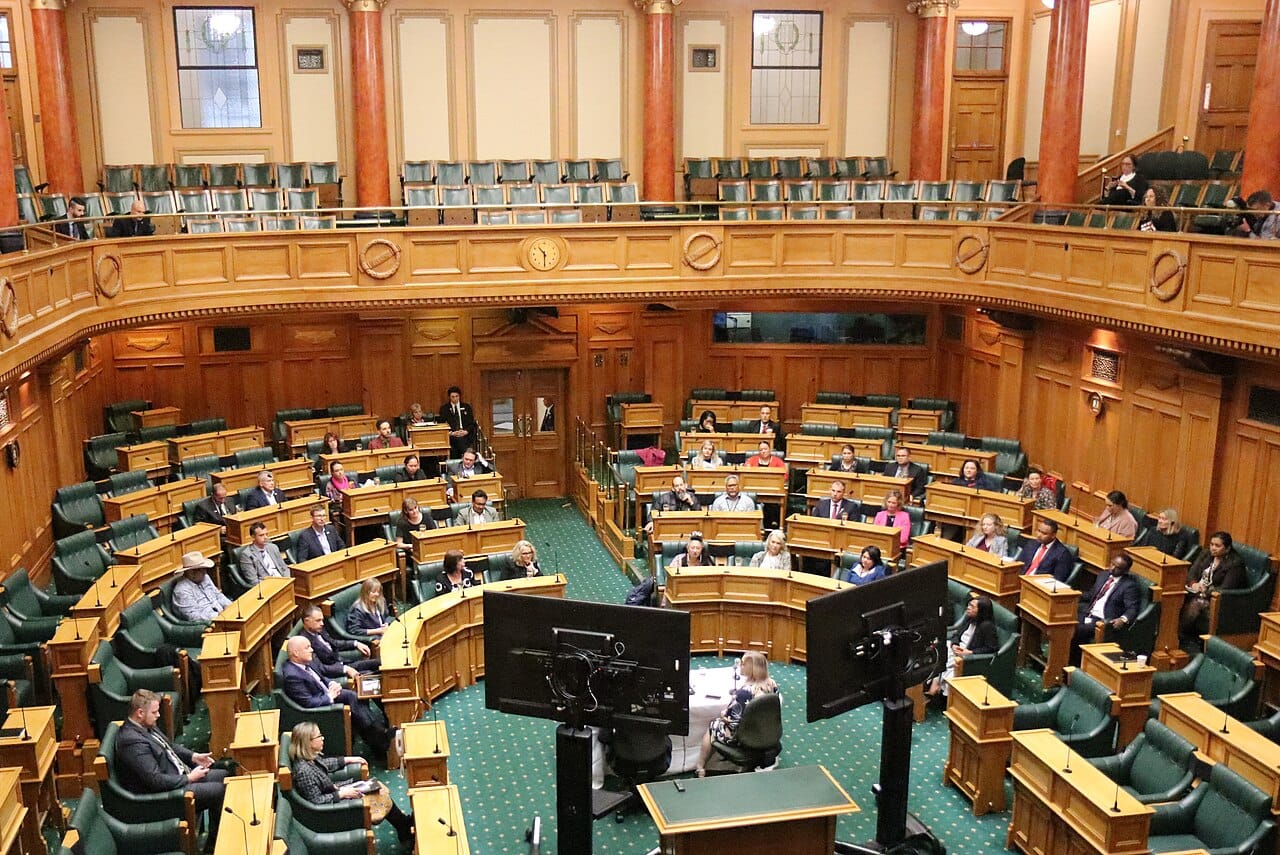
All the views and opinions expressed are those of the author. Image Credit: Office of the Clerk of the House of Representatives of New Zealand.
About the Author
Jaiee Ashtekar holds a bachelor’s degree and a master’s degree in political science from the University of Mumbai. She holds a post-graduate diploma in international relations from the University of Strathclyde, United Kingdom (UK). She has done projects titled “Kashmir through Political Perception” and “Water issues between India and Pakistan.”