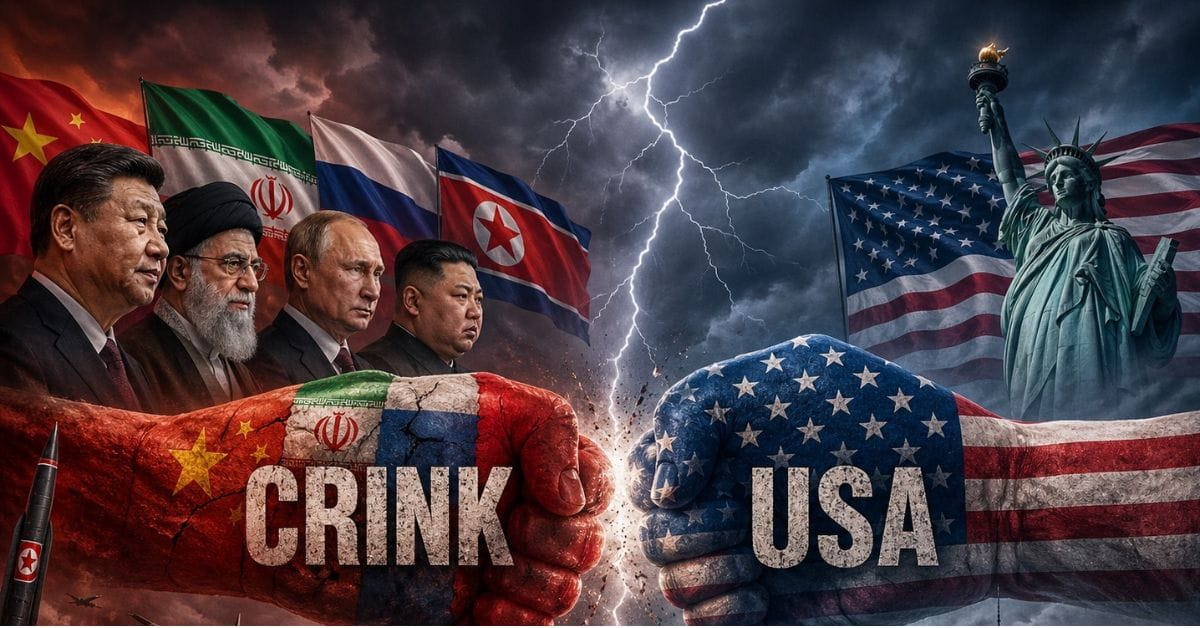
On January 3, 2026, United States forces executed Operation Absolute Resolve, a predawn military strike on Caracas that resulted in the capture of Venezuelan President Nicolás Maduro and his wife, Cilia Flores. The operation, which involved suppressing Venezuela’s air defences and extracting Maduro from his compound within hours, sent shockwaves across the international system. The response from China, Russia, Iran, and North Korea, the adversary coalition often termed CRINK or the Adversary Entente was swift and coordinated. Beijing condemned the move as deeply shocking hegemonic aggression.
Moscow declared it armed aggression against sovereignty. Tehran framed it as a flagrant violation demanding resistance to external coercion. Pyongyang characterised it as hegemonic encroachment threatening all sovereign states. These responses reveal a pattern: CRINK leaders are not merely condemning the U.S. action but leveraging it strategically to reinforce their own anti-U.S. norms of sovereignty, non-intervention, and multipolarity.
The Unified Normative Frame
From China
Beijing’s response to the Venezuelan intervention demonstrates how China weaponises sovereignty discourse to advance its broader strategic interests. China strongly condemned what its Foreign Ministry spokesperson termed the U.S.’s blatant use of force against a sovereign state, calling the action deeply shocking and describing it as hegemonic acts that seriously violate international law and Venezuela’s sovereignty. Chinese officials emphasised that such actions threaten peace and security in Latin America and the Caribbean region, positioning the United States as a destabilising force rather than a defender of international law.
This framing serves China’s long-standing anti-interventionist rhetoric, which Beijing deploys consistently to counter U.S. criticism of Chinese policies in Hong Kong, Xinjiang, and the South China Sea. By presenting itself as the defender of multilateral norms against unilateral force, China seeks to position itself as the responsible global superpower. Chinese President Xi Jinping, without explicitly mentioning the U.S., stated during a meeting with Ireland’s Prime Minister that the world was experiencing turbulence and that unilateral bullying seriously impacts the international order, adding that all countries should respect the development path independently chosen by other peoples and abide by international law.
China’s messaging carries particular weight given its economic relationship with Venezuela. As the largest buyer of Venezuelan oil and a creditor holding billions in oil-backed loans, China frames its opposition not merely as principle but as defence of legitimate economic partnerships. Chinese officials have argued that Venezuela has the right to develop mutually beneficial cooperation with other countries, and that the international community supports Venezuela’s position.
Beijing has used the Venezuela episode to contrast its approach with Washington’s, presenting itself as a force for stability while characterising U.S. actions as evidence of declining American commitment to the rules-based order it claims to champion. The narrative resonates particularly in the developing world, where China has cultivated partnerships through its Belt and Road Initiative and South-South cooperation frameworks. By emphasising that such hegemonic acts hollow out decades of U.S. rhetoric positioning America as the guardian of international rules, China advances its vision of a multipolar world order where Western powers cannot act with impunity.
From Russia
Moscow’s declaration of the Venezuelan raid as armed aggression reflects Russia’s broader strategy of highlighting Western double standards. Russia’s Foreign Ministry called for the immediate release of the lawfully elected president of a sovereign country, emphasising that the situation must be resolved through dialogue rather than military force. Foreign Minister Sergei Lavrov personally contacted Acting Venezuelan President Delcy Rodríguez to express strong solidarity with the government, while Russia requested an urgent UN Security Council meeting to address what it termed an unacceptable infringement on the sovereignty of an independent state.
Russia’s response employs a familiar rhetorical pattern: casting U.S. actions as exemplifying the very behaviour Washington condemns in others. Russian statements emphasised that ideologised hostility has prevailed over practical pragmatism, framing the U.S. as abandoning trust-based relations in favour of aggressive unilateralism. This messaging directly parallels Moscow’s justifications for its own actions in Ukraine and its sphere of influence, where Russia claims to be defending Russian-speaking populations and resisting NATO expansion.
The Venezuelan intervention provides Moscow with powerful ammunition to argue that if the United States asserts order by force in its hemisphere, other great powers possess similar prerogatives in their regions. Russia has historically suggested sphere-of-influence arrangements, with former Trump administration officials noting that during previous standoffs, Moscow singled interest in a Venezuela-Ukraine swap: American withdrawal from Venezuela in exchange for reduced Russian involvement in Ukraine. While Putin himself has remained notably silent on Maduro’s capture likely calculated to avoid antagonising the Trump administration during ongoing Ukraine negotiations; Russian diplomatic machinery has worked to frame the episode as proof of American hypocrisy.
This restraint reveals Russia’s strategic priorities: Ukraine remains Moscow’s overwhelming focus, and the Venezuela operation demonstrates Russian limits in projecting conventional military power globally. Yet rhetorically, Russia leverages the incident to bolster arguments that Western claims to uphold international law are selective and self-serving, applicable only when convenient to Western interests.
From Iran
Tehran’s portrayal of the U.S. intervention employs religiously inflected nationalist language that resonates with its domestic audience and regional allies. Iran’s Foreign Ministry strongly condemned what it described as a blatant violation of Venezuela’s national sovereignty and territorial integrity, characterising the attack as a grave breach of regional and international peace and security. Iranian statements emphasised that the military aggression represents a textbook example of an act of aggression that must be condemned by the United Nations and all states concerned with upholding the rule of law.
This response aligns seamlessly with Iran’s broader discourse of defending autonomy against what Iranian leaders term the Great Satan i.e., American hegemony that seeks to impose its will on independent nations. Supreme Leader Ayatollah Ali Khamenei, while not addressing Venezuela directly, stated during this period that when one realises the enemy is arrogantly trying to impose something on the country and officials, one must stand firmly against the enemy and bare one’s chest in resistance, declaring that Iran will not yield to the enemy.
Such language, while ostensibly about domestic issues, clearly references the Venezuelan precedent. For Tehran, the Venezuelan intervention carries particular urgency given Iran’s own vulnerabilities. The Islamic Republic faces criminal indictments from Washington, comprehensive sanctions, political isolation, and ongoing domestic unrest. Trump’s suggestion that he was weighing very strong options on Iran as demonstrations escalated raised immediate parallels to the Venezuelan operation. Israeli officials explicitly warned Iranian leaders to pay close attention to developments in Venezuela, while analysts note that the operation unsettles a core Iranian assumption: that leadership insulation and escalation risk reliably constrain U.S. action.
Iran’s response therefore serves dual purposes: externally, it positions Tehran as defender of sovereignty and opponent of imperial aggression, strengthening ties with nations wary of Western intervention; internally, it reinforces narratives of external threat that the regime uses to justify repression and military spending, particularly on deterrent capabilities. Iran’s characterisation of U.S. actions as violating fundamental UN Charter principles, including the prohibition on the use of force, provides rhetorical cover for Iran’s own regional activities while positioning resistance to American pressure as principled defence of international law.
From North Korea
Pyongyang’s characterisation of the Venezuelan raid as U.S. hegemonic encroachment reveals how the DPRK instrumentalists the episode to justify its own security posture. North Korea’s Foreign Ministry denounced the United States’ capture of Maduro as a serious encroachment of sovereignty, with a spokesperson stating that they strongly condemn the U.S. hegemony-seeking act committed in Venezuela. The ministry added that the incident clearly confirms once again the rogue and brutal nature of the U.S., using language consistent with decades of North Korean propaganda.
For Pyongyang, the Venezuelan operation represents a nightmare scenario that validates its longstanding security narrative. North Korean leaders have consistently portrayed U.S. policy as aimed at regime change, using this threat to justify the country’s nuclear weapons program and ballistic missile development. The capture of Maduro, a leader the U.S. criminally indicted and then forcibly removed through military action provides concrete evidence for North Korean arguments that only robust military deterrence, particularly nuclear capability, can protect sovereign states from U.S. interference.
North Korea frames the raid as a direct threat to all sovereign states, including itself, transforming a Venezuelan-specific incident into an existential warning. This messaging serves multiple purposes: it reinforces internal narratives about external threats requiring sacrifice and obedience; it justifies continued weapons development despite international sanctions; and it positions North Korea’s nuclear program not as aggressive provocation but as defensive necessity against a United States willing to employ military force to remove leaders it opposes.
Pyongyang’s vocal backing of Venezuela’s socialist regime now takes on new significance. The DPRK has consistently supported Maduro, and North Korea’s response to his capture emphasises solidarity among states resisting U.S. pressure. By leveraging the Venezuelan example to underscore arguments for military deterrence as protection against U.S. interference, North Korea transforms regional events into validation of its strategic choices, potentially complicating denuclearisation negotiations and reinforcing Pyongyang’s conviction that nuclear weapons provide the ultimate guarantee of regime survival.
All the views and opinions expressed are those of the author. Image Credit: THE VIYUG.
About the Author
Mansi Suryavanshi is a research consultant for The Viyug. She has developed expertise in paralegal services and research work related to judgements for assisting legal work. She previously worked as an assistant professor at the Department of Physics in PG College.