The public record on China’s response to the Iran war is clear and unremarkable. Since US and Israeli forces launched Operation Epic Fury on February 28, Beijing has condemned the strikes as violations of international law, called for an immediate ceasefire, and dispatched Special Envoy Zhai Jun to the region. It has evacuated over 3,000 Chinese citizens from Iran. Foreign Minister Wang Yi has made calls to counterparts in Russia, Iran, Oman, France, Israel, Saudi Arabia, and the UAE. The messaging has been consistent, calibrated, and to anyone watching Chinese diplomacy instantly recognisable: urge restraint, oppose unilateralism, protect sovereignty, return to dialogue.
On the surface, Beijing appears to be doing precisely what it always does in a crisis it did not start. That surface reading is incomplete. Below the diplomatic formula, China is running a three-track operation simultaneously one economic, one military, and one that belongs in the vocabulary of strategic intelligence rather than statecraft. Beijing is not a passive spectator wringing its hands over a war it cannot stop. It is the most consequential observer in this conflict, and what it learns, absorbs, and quietly secures in the coming weeks may shape the military balance in the Pacific for a decade.
The Oil Floor
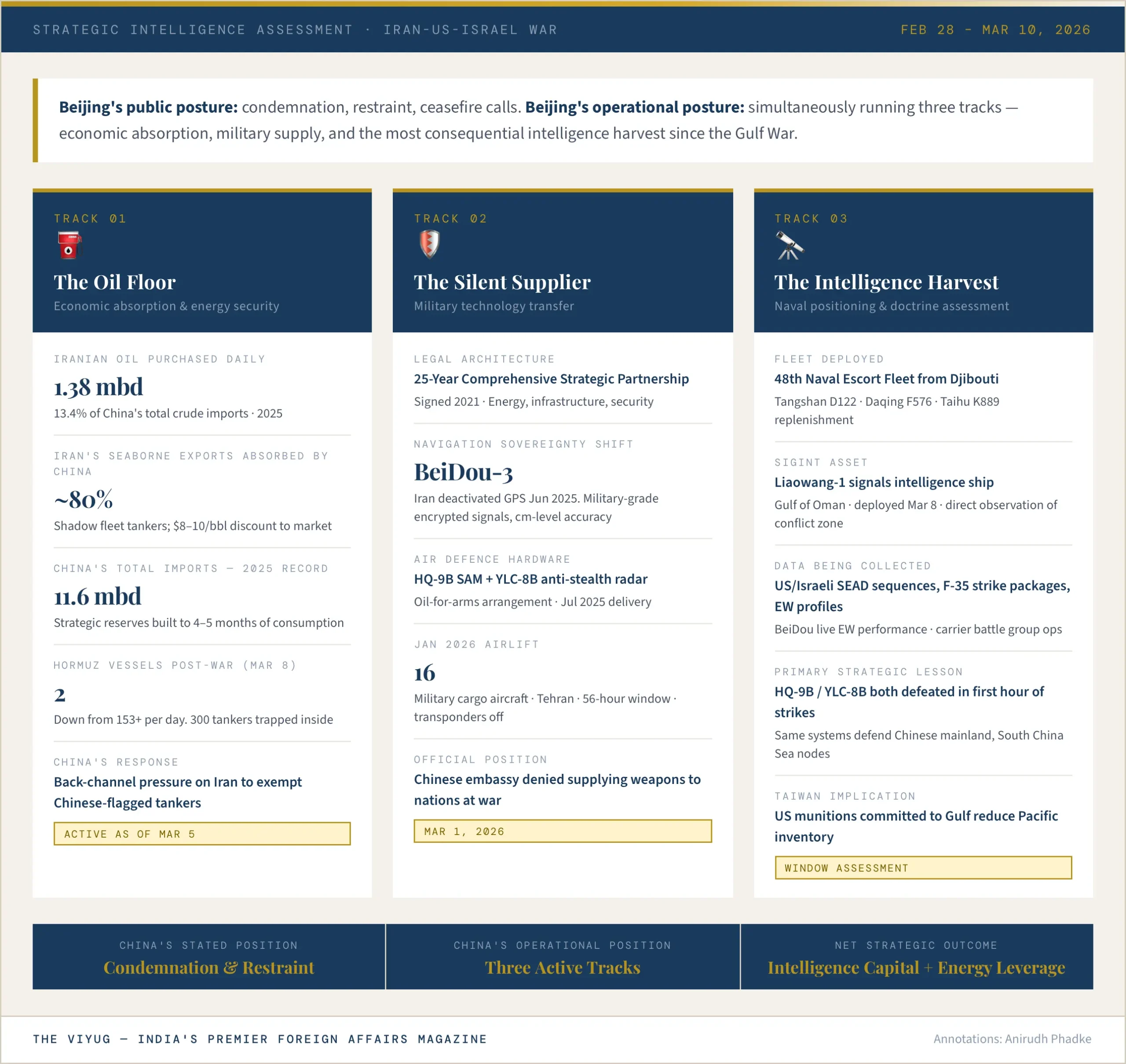
Start with the economic track, because its scale clarifies everything else. In 2025, China purchased 1.38 million barrels of Iranian oil per day, a figure representing roughly 13.4 percent of its total crude imports and approximately 80 percent of all Iranian seaborne oil exports, according to Kpler data. Combined with Venezuelan crude, sanctioned oil from both countries constituted an estimated 17 to 18 percent of China’s total oil imports at the end of last year.
Iran and Venezuela did not merely provide volume; they provided it cheap at discounts of $8 to $10 per barrel below prevailing market rates, a pricing model that the independent ‘teapot’ refineries of southern China had built entire business models around. China’s crude oil imports hit a record 11.6 million barrels per day in 2025, as Beijing took advantage of low prices and geopolitical oversupply to build strategic reserves estimated at four to five months of consumption.
The war has now placed that infrastructure under direct stress. Since the conflict began, Strait of Hormuz transits collapsed from a pre-war average of over 153 vessels per day to a mere two outbound crossings recorded on March 8 which is 99 percent disruption according to maritime tracking data from CSIS and Windward Maritime AI. Crude oil prices surged more than 15 percent in the first week of the conflict. Around 300 oil tankers remain trapped inside the Strait, unable to transit safely. On March 1, Qatar halted production at Ras Laffan, the world’s largest LNG export facility, after an Iranian drone strike China’s single largest LNG supplier, accounting for roughly 30 percent of its imports.
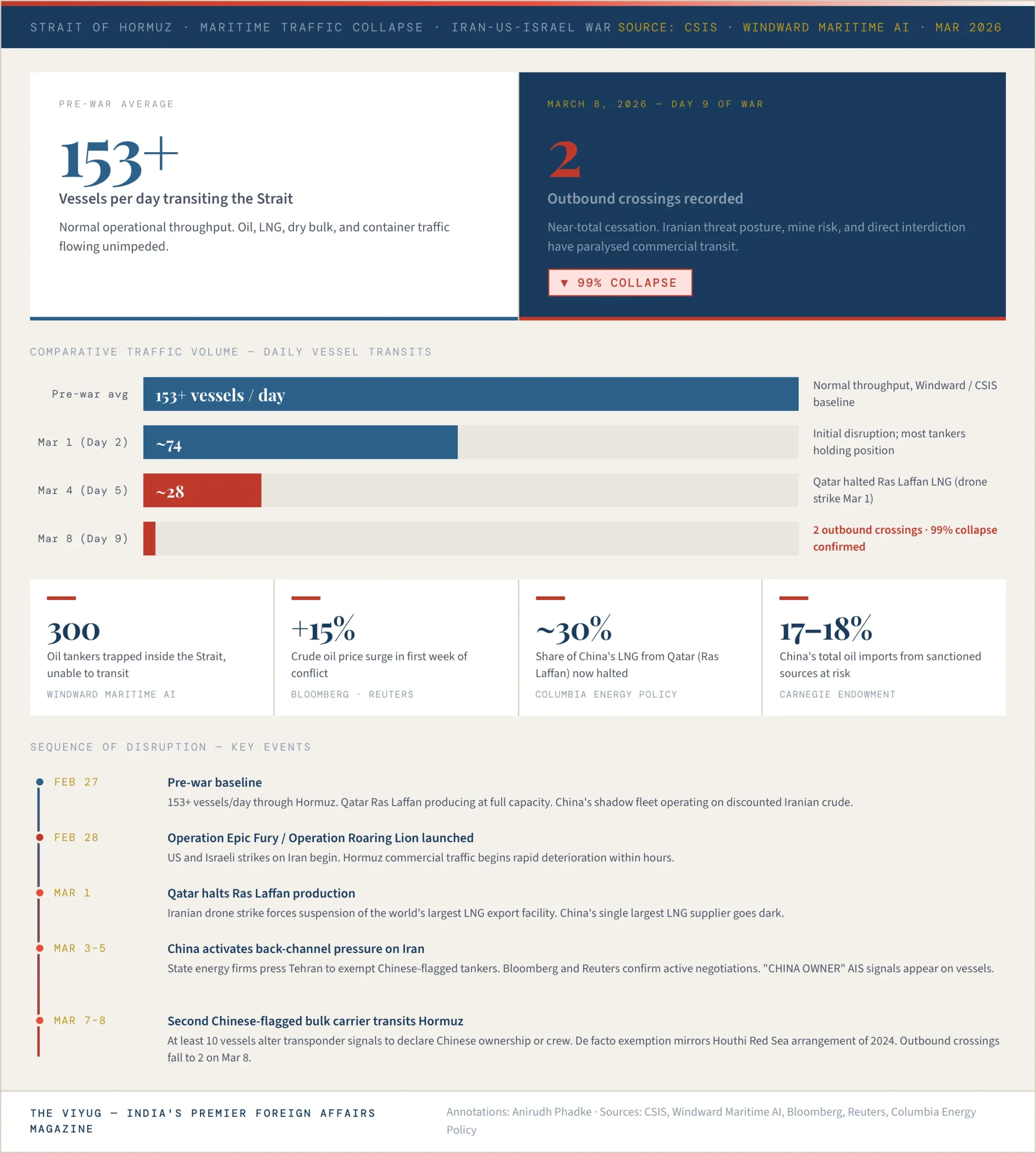
Beijing’s response has been characteristically indirect. Through back channels, Chinese state energy firms briefed by government officials have been pressing Iranian counterparts to guarantee safe passage for Chinese-flagged and Chinese-owned oil and gas tankers, and specifically to refrain from targeting Qatari LNG shipments. Bloomberg and Reuters both reported active negotiations along these lines by March 5. The tactic has already begun to take visible form: at least ten commercial vessels have altered their AIS transponder signals to broadcast “CHINA OWNER” or “ALL CHINESE CREW” while transiting the Strait, hoping to be treated as neutral traffic under a de facto Chinese exemption mirroring the arrangement the Houthis extended to Chinese vessels in the Red Sea in 2024.
The financial logic is unambiguous. China has strategic reserves sufficient to absorb a short disruption. A prolonged closure, or worse, a permanent disruption of the shadow fleet supply chain, would force it to replace discounted Iranian crude with Gulf, Russian, or Brazilian oil at higher market prices, eroding the margins of an entire segment of its industrial economy.
The Silent Supplier
The military supply track is more sensitive, and Beijing is predictably more opaque about it. The formal architecture is well-established: the 25-year Comprehensive Strategic Partnership signed between China and Iran in 2021 provides the legal scaffolding for long-term cooperation across energy, infrastructure, and security sectors. Under this arrangement, China has progressively embedded its military and technological standards into the backbone of Iranian defence infrastructure.
The most operationally significant transfer has been navigation sovereignty. In June 2025, following the disruptions of the 12-day Israel-Iran conflict, Iran formally deactivated GPS reception nationwide and completed a transition to China’s BeiDou-3 Navigation Satellite System, a shift institutionalised under the 2021 partnership, which granted Iran access to BeiDou’s encrypted, military-grade positioning signals. Unlike GPS, BeiDou incorporates a short-message service allowing Iranian command nodes to communicate via satellite even when terrestrial networks are down or jammed.
The system provides centimetre-level accuracy to authorised military users and is designed to operate in contested electromagnetic environments, precisely the conditions that US and Israeli electronic warfare created on February 28. Before the transition, GPS jamming during the 2025 conflict had significantly degraded the accuracy of Iranian missile and drone strikes. The BeiDou shift was Iran’s direct response.
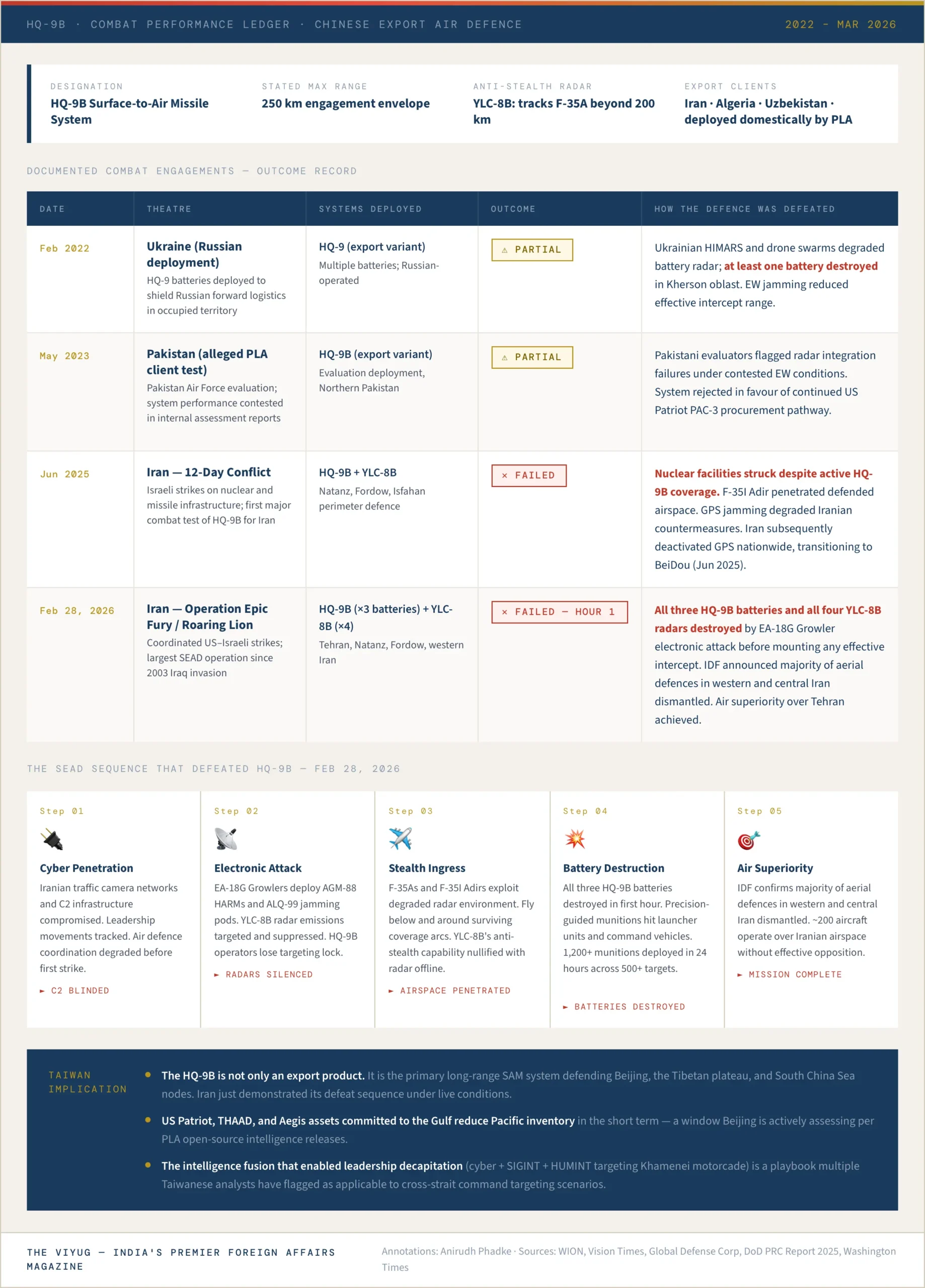
Hardware deliveries have followed the same logic. The YLC-8B, a Chinese anti-stealth radar system capable of detecting targets with a radar cross-section of one square meter at ranges between 270 and 330 kilometres, and of tracking the F-35A at distances exceeding 200 kilometres was supplied to Iran as part of the expanding cooperation framework. In July 2025, Iran reportedly acquired the HQ-9B long-range surface-to-air missile system through an oil-for-arms arrangement, deployed to protect nuclear facilities at Natanz and Fordow and military installations around Tehran.
In January 2026, Israeli media reports cited by defence analysts described 16 Chinese military transport aircraft landing in Tehran within a 56-hour window, with transponders turned off reportedly carrying advanced air defence systems, electronic warfare equipment, and potentially anti-ship missiles. The Chinese embassy in Israel, after the February 28 strikes, denied that China supplies weapons to countries engaged in warfare. Iranian officials had previously confirmed receipt of the HQ-9B in significant numbers.
The Fleet in Position
China’s third track is naval and intelligence positioning its most visible operational move, and the one most often misread as a symbolic gesture. At the start of March, Beijing dispatched its 48th Naval Escort Fleet from its base in Djibouti toward the Strait of Hormuz. The formation consists of the Type 052DL guided-missile destroyer Tangshan (D122), the Type 054A anti-submarine warfare frigate Daqing (F576), and the Type 903A replenishment ship Taihu (K889), a combination of layered anti-ship, anti-submarine, and logistical capabilities that projects far beyond a courtesy call. The deployment is part of the ongoing Maritime Security Belt 2026 trilateral exercises involving China, Russia, and Iran in the Strait of Hormuz and northern Indian Ocean.
More telling than the warships is a quieter vessel. On March 8, the Liaowang-1, a Chinese signals intelligence ship was deployed to the Gulf of Oman, placing a dedicated maritime surveillance platform within direct observation range of the active conflict zone. Separately, PLA-linked analysts and social media accounts have been systematically publishing satellite imagery and flight-tracking data purporting to document US bomber deployments, carrier movements, and strike package compositions near Iran.
This pattern of open-source intelligence (OSINT) signalling that serves the dual purpose of demonstrating China’s surveillance reach while feeding its ongoing operational assessment of US military doctrine. The fleet presence is not a deterrent against US and Israeli action. It is a collection of ears in the water and eyes in the sky, watching what the most advanced military coalition in the world looks like when it is not constrained by political hesitation.
The Intelligence Harvest
This is where the article’s core argument lives. The failure of Iran’s air defence network on February 28 was a catastrophe for Tehran and a revelation for Beijing. The Chinese-manufactured HQ-9B batteries deployed around Tehran, Natanz, and Fordow systems delivered to Iran as recently as July 2025 through an oil-for-arms deal were reportedly neutralised in the first hour of the strikes. According to defence analyst assessments, three batteries of HQ-9B and four YLC-8B anti-stealth radar systems were destroyed by US EA-18G Growler electronic warfare aircraft before they could mount any effective response. The IDF subsequently announced it had dismantled the majority of aerial defence systems in western and central Iran, establishing air superiority over Tehran.
This outcome is not primarily a problem for Iran. It is a problem for China. The HQ-9B is not merely an export product. It is deployed around Beijing, the Tibetan plateau, and the South China Sea to protect the most sensitive nodes in the Chinese mainland’s own air defence architecture. The YLC-8B is a cornerstone of China’s anti-stealth posture. Both systems now carry a verified combat record of failure against a coordinated SEAD — Suppression of Enemy Air Defenses — package using fifth-generation fighters, electronic warfare aircraft, precision-guided munitions, and cyber operations.
As Shu Hsiao-Huang of Taiwan’s Institute for National Defense and Security Research assessed, the US military’s SEAD execution was highly effective, validating sustained American investment in fifth-generation aircraft and long-range precision strike. John Culver, a former CIA senior analyst on China’s military, was blunter: “The force that China has built looks highly capable on paper, but they haven’t been to war in a very long time.”
For Beijing’s war planners, every strike sequence over Iran is a data point of the highest strategic value. The war has already revealed how US and Israeli intelligence fused cyber penetration (the compromise of Iranian traffic camera networks to track leadership motorcades), signals intelligence, and human sources to achieve a real-time operational picture precise enough to kill the Supreme Leader. It has shown how BeiDou performs or struggles under active electronic jamming.
It has demonstrated the endurance of US precision strike capabilities at scale: approximately 200 Israeli fighter jets struck over 500 targets in the first 24 hours, using over 1,200 bombs. And it has revealed exactly how many Patriot reloads, Aegis destroyers, and THAAD systems Washington is willing to commit to a single theatre assets that were, until February 28, earmarked for the Pacific.
China can draw three immediate lessons. First, its own air defence system has a documented vulnerability against coordinated SEAD operations led by stealth aircraft and it now knows the specific tactical sequence that exploits it. Second, the US’s willingness to concentrate high-value munitions in the Gulf has measurably reduced the inventory available for a Taiwan contingency, at least in the short term. Third, the precision intelligence fusion that enabled the elimination of Iran’s supreme leadership is a playbook that cuts in every direction including, as multiple Taiwanese analysts have noted with urgency, toward Taipei.
Ending Note
Beijing’s condemnations have been genuine in one narrow sense: China did not want this war, at this moment, in this form. The disruption to its energy supply chain is real and costly. The destruction of Iranian infrastructure threatens long-term Chinese investments estimated at $4.7 billion in Iran and the Bandar Abbas logistics corridor central to the Belt and Road Initiative. The BeiDou transition that China spent years engineering as a strategic advantage has now had its limits exposed under live fire.
But China is not simply absorbing losses. It is converting a crisis it did not choose into intelligence capital that no exercise, simulation, or espionage operation could have generated. The West is fighting a war. Russia is taking notes on munitions depletion. China is doing something more methodical: it is running the most consequential assessment of US and Israeli military doctrine since the Gulf War of 1991, the last time the world watched a US-led coalition dismantle a heavily defended adversary at scale.
The difference is that in 1991, China was a peripheral observer with no immediate stake in the lessons. In 2026, it has a 2027 deadline of its own, a system of air defences that just failed a live test, and an island it has not given up on.
Featured Image Credit: @brgfx via Freepik.
About the Author
Anirudh Phadke is the Founder, Publisher & Editor of The Viyug. He previously worked for International Criminal Police Organization (INTERPOL). He was also a Member of the Board of Studies (BoS) for the Department of Defence & Strategic Studies at the Guru Nanak College (Autonomous). Anirudh holds a Master of Science in Strategic Studies along with a Certificate in Terrorism Studies from S. Rajaratnam School of International Studies (RSIS) at Nanyang Technological University (NTU). He completed Bachelor’s degree in Defence & Strategic Studies from Guru Nanak College (Autonomous).