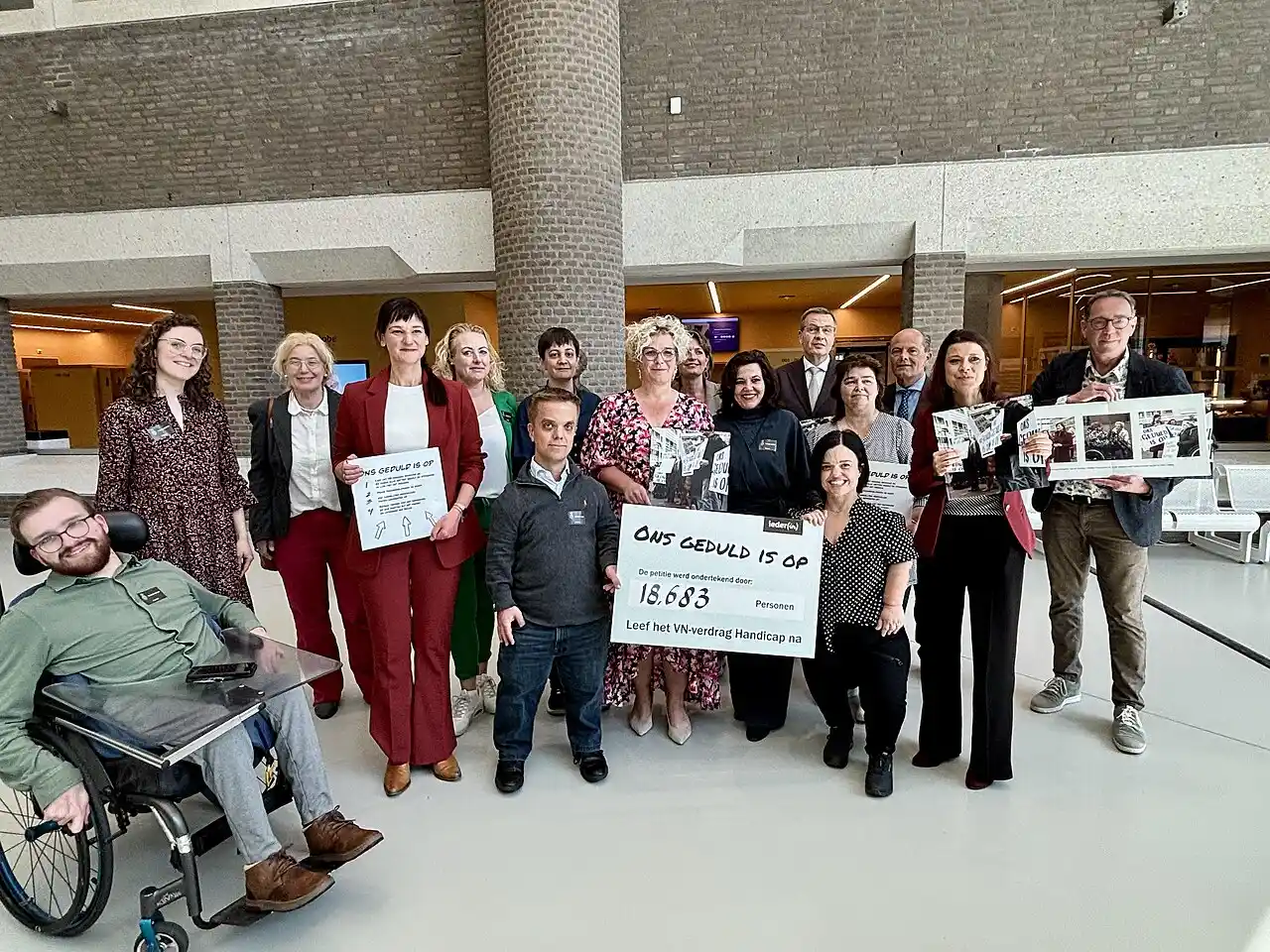
The Convention on the Rights of Persons with Disabilities described disabled people as rights-holders even during war, not as charity recipients. Article 11 of the Convention acknowledges that armed conflict and humanitarian emergencies exacerbate vulnerabilities, rather than just creating new ones. The framework considers disability as a pre-existing social reality, making neglect during war as a failure of state responsibility. Despite this, implementation during prolonged wars remains weak, exposing the gap between legal recognition and lived reality.
Most humanitarian systems are designed around the “able-bodied norm”, prioritising speed, mobility, and self-navigation. Disabled people are not excluded intentionally, but structurally, through inaccessible structure of the shelters, information and aid distribution. In long wars, emergency responses become permanent systems, institutionalising exclusion rather than correcting it. Reports over the years have consistently shown disabled people are less likely to evacuate, more likely to be left behind, and rarely consulted in aid design. These patterns indicate towards systemic invisibility, and are not isolated failures. More often than not, these rights violations against disabled people in war often go unreported because they are framed as logistical issues, not discrimination.
According to The Minority Body, disability is a stable social identity, not an exceptional or temporary condition. Societies are structured around a majority body, making disabled people permanently marginal. In war, this marginality becomes more visible because systems collapse, but the exclusion already existed. War does not create disabled vulnerability, instead it removes the minimal supports that previously masked it. As per the Crip Theory proposed by Robert McRuer, disabled bodies challenge dominant narratives of strength, heroism, and resilience, which are central to war politics. War cultures glorify endurance and sacrifice, which makes disabled loves politically inconvenient. Disabled survival during long wars becomes a form of quiet resistance to these norms.
War is a total social environment, not just a temporary rupture, which reshapes daily life, institutions and moral priorities over time. Long wars tend to normalise instability, making crisis the default condition rather than an exception. War leads to violence for disabled people through continuous erosion of care, access, and autonomy. There is another related idea of slow violence, which related to the harm that unfolds gradually, invisibly, and bureaucratically. Viewing war as a condition reveals how exclusion becomes institutionalised over time rather than caused by isolated failures.
Most often, disabled people are excluded by design, not by oversight, through inaccessible shelters, aid queues, and information systems. International Committee of the Red Cross (ICRC) classified disabled people, as civilians, but humanitarian practice treats civilians as a homogenous group. This erases unequal capacities to endure prolonged conflict, especially where survival depends on speed, flexibility, and independence. Consequently, disabled people remain undercounted, under-prioritised, and politically marginal within humanitarian response systems.
Another important aspect is that violence is not always immediate or spectacular, it can be gradual, delayed and invisible. Slow violence is often harder to recognise, record, or respond to. Long wars operate primarily through slow violence for civilians, especially disabled people. Disabled people also experience effects of war through delayed medical care, bureaucratic neglect, breakdown of support systems, or exhaustion of caregivers and resources.
Pre-War Marginalisation as the Baseline
Disability rights framework often lack enforcement, funding, and monitoring mechanisms, and exist just on paper. State institutions tend to treat disability as a sectoral or welfare issue, and not as a cross-cutting governance concern. Designing of public services like health, education, transport and social protection is done by keeping in mind only the able-bodied people. Institutional accessibility is not given much importance, and is viewed as optional or secondary, rather than integral to service delivery. Moreover, disabled people’s voices are often not heard while making important decisions in advisory councils, and crisis governance structures. Administrative procedures often prove to be complex, inflexible and inaccessible. As a result, it is not just when wars begin that institutions “break down” for disabled people- they were actually never built to support them in the first place.
Even prior to conflicts, disabled people are disproportionately concentrated in low- and middle-income households. Employment opportunities are largely confined to informal, insecure, and low-paid work, with little protection. Social protection systems are weak, inadequate and exclusionary, often tied to documentation or regular assessments. Income insecurity reduces the ability to stockpile resources, relocate or adapt during prolonged instability. Moreover, disabled people often lack savings, assets or credit access, increasing their burden on others such as family members, or caregivers. Poverty and disability reinforce each other, creating cumulative disadvantage over time.
Physical spaces are designed keeping in view the able-bodied movement, making everyday navigation restrictive for disabled people even before conflict. Disabled people often only venture into known territories, stable routes and familiar environments. War disrupts these roads, public transport and neighbourhood layouts, making even the few disabled-friendly routes into obstacles. Evacuation systems assume speed, independence, and physical endurance, excluding many disabled people by default. Disabled people may also miss out on important information due to sensory, cognitive or other communication barriers.
Conflict politics prioritise security, territory, and military survival, sidelining social welfare concerns. Disability issues are framed as secondary or non-urgent, even during prolonged crises. Wars disrupt the ability to plan beyond the immediate present. Long wars replace predictability with chronic uncertainty. Families and caregivers experience anticipatory exhaustion, not just crisis fatigue. The prolonged nature of war transforms temporary disruption into permanent precarity.
Long War as an Amplifier of Everyday Barriers
Routine medical care, meditation, therapy, and maintenance of assistive device become difficult due to ravages caused by the war. Health systems ignore chronic and long-term needs to shift all their focus towards immediate emergency needs. Supply chain disruptions make continuity of care impossible to sustain. For disabled people, loss of routine care is not just inconvenient, but also life-threatening.
Ravaged roads, transport shutdowns, and damaged public spaces add-on to the already existing mobility barriers. Frequent checkpoints, curfews, and surveillance regimes assume speed and bodily compliance, due to which disabled people face unnecessary hassles. Disabled people lose autonomy as survival now depends on increasingly fragile social arrangements. Instead of support, care becomes a site of power and vulnerability.
Wars of long duration disrupt caregiving networks via displacement, injury, and financial strain. Greater dependency increases potential for neglect, control, and abuse. People with disabilities are stripped of autonomy as their survival relies on progressively more tenuous social configurations. Care is a place of power and vulnerability, not consolation, or source of strength.
Response to emergencies is focused on being mobile, self-navigating and quickly obedient. Distribution of aid, shelters, and information are structurally off-limits. People with disabilities are not excluded by design but by design assumptions. In due course humanitarian exclusion becomes institutionalised.
Time, Anticipation and Slow Violence
Wars are prolonged until conflict becomes a permanent fact of life rather than a temporary disruption. For the disabled, war is lived in duration rather than intensity. Making it through is dependent less on fleeing violence and more on enduring turbulence for a long time.
Disabled lives are dependent on anticipation and scheduling: medication refills, care routines, income, mobility assistance. Long wars degrade even the capacity for short-term planning. Uncertainty takes the place of routine, and it is mentally and physically draining just to get through the day. The damage to anticipation is itself a harm, not simply something caused by conflict.
Harm is in the process of progressive devastation, according to Slow Violence and the Environmentalism of the Poor, through: delays, neglect, attrition, and bureaucratic indifference. People with disabilities are more likely to feel the effects of war in its low intensity violence than in the direct strike itself. It’s a type of violence that is more difficult to record, quantify, or politicise.
When wars grind on, lack becomes normal. Short-term adjustments become long-term adaptations for survival. The failure of institutions is recast as fate rather than political decision. Disabled pain turns into white noise not a calamity. Lengthy wars gradually wear down the strength of caregivers over time. Families have anticipatory fatigue, not just crisis fatigue. Mutual aid networks atrophy, leaving people more isolated and abandoned. Care becomes precarious and unreliable.
Slow violence is not amenable to dramatic images, and it is barricading disabled people outside of dominant war narratives. The media and policy are concerned with victims and displacement, not lives lived in expectation. People are disabled are still undercounted, because the damage they experience is gradual.
Conclusion
Long wars do not merely harm disabled people; this reveals how war itself is structured around able-bodied survival. Disabled people experience conflict as a permanent condition, not just a temporary crisis. Harm unfolds primarily through time, neglect, and erosion of care, rather than spectacular violence. The fact that disabled people are not part of war is systemically and politically enforced and was never going to be otherwise.
Disability is still considered to be a side issue in humanitarian and government structures, despite the fact that it is the key to the survival of civilians. Ostracising those with disability creates a morally incomplete understanding of war. A just conception of war will need to consider those who cannot run, hide, or tough it out in able-bodied ways. Peace-building and reconstruction without disability at the centre are likely to reproduce the marginalisation experienced in wartime. Disabled lives reveal the real, long-term price of war — not just the death toll and the ceasefires.
References
- United Nations. (2006). Convention on the Rights of Persons with Disabilities. United Nations.
- Smith, F., & MacLachlan, M. (2019). Disability and humanitarian action. In S. Grech & K. Soldatic (Eds.), Disability in the Global South: The critical handbook (pp. xx–xx). Springer.
- McRuer, R. (2006). Crip theory: Cultural signs of queerness and disability. New York University Press.
- Scheper-Hughes, N., & Bourgois, P. (Eds.). (2004). Violence in war and peace: An anthology. Blackwell Publishing.
- Farmer, P. (2004). An anthropology of structural violence. Current Anthropology, 45(3), 305–325.
- Mitra, S., Posarac, A., & Vick, B. (2013). Disability and poverty in developing countries: A multidimensional study. World Development, 41, 1–18.
- Imrie, R. (2012). Universalism, universal design and equitable access to the built environment. Disability & Rehabilitation, 34(10), 873–882.
- Groce, N., Challenger, E., Berman-Bieler, R., Farkas, A., Yilmaz, N., Schultink, W., & Clark, D. (2011). Disability and the post-2015 development agenda. The Lancet, 374(9704), 1801–1803.
- Vigh, H. (2008). Crisis and chronicity: Anthropological perspectives on continuous conflict and decline. Ethnos, 73(1), 5–24.
- Nixon, R. (2011). Slow violence and the environmentalism of the poor. Harvard University Press.
- Trani, J. F., Bakhshi, P., Bellanca, N., Biggeri, M., & Marchetta, F. (2015). Disabilities through the capability approach lens. World Development, 70, 207–221.
All the views and opinions expressed are those of the author. Image Credit: Xavier020.
About the Author
Archita Gaur is a postgraduate student at the School of International Studies, Jawaharlal Nehru University (JNU). She specialises in the world economy and has a strong interest in public policy, economic research, and governance.