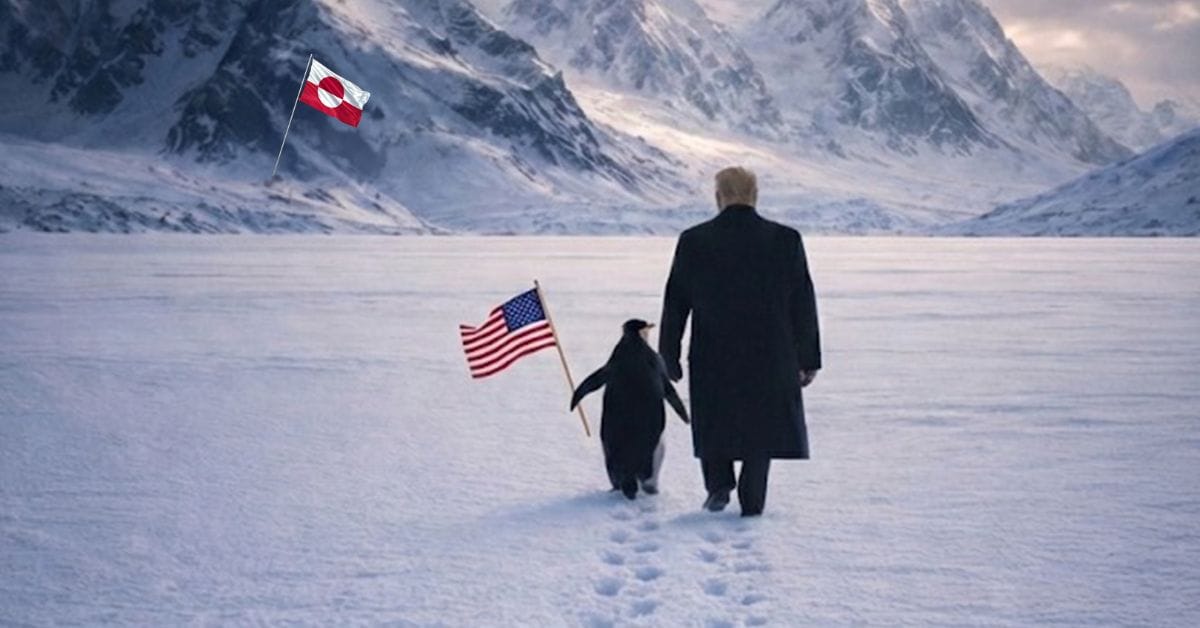
President Donald Trump said on January 9 that his administration will take action on Greenland “whether they like it or not,” and this time it seems serious as he pushes to acquire the Danish territory for the United States. After January 3, when Venezuelan leader Nicolas Maduro was ousted from Caracas, the American President is adamant about seizing control of the 836,330-square-mile island of Greenland, which is bigger than Alaska.
Trump’s November 2025 National Security Strategy clearly outlined its approach to addressing its most serious national security challenges, namely the Western Hemisphere. The protection of American territory from peer competitors and adversaries, such as China and Russia, has pushed Washington, DC’s security elites to be creative. In this regard, the concepts of Iron Dom and the seizure of Greenland emerged. Geography is dictating here.
The question of Greenland’s seizure overtook the assumption of mineral acquisition, and a new perspective on the control emigres shows that protecting the American territory from Chinese and Russian Intercontinental ballistic missiles (ICBMs) requires the acquisition of Greenland. If we look at the globe and identify Greenland’s location, we find it is strategically situated between the territory of the North Atlantic Treaty Organisation (NATO) and Russia.
The island sits where the two oceans meet: The Atlantic and Arctic oceans. It is located between the GIUK Gap (a stretch of ocean between Greenland, Iceland, and the UK) and the Bear Gap (further North), which is strategically the most vital territory in the region. These are the essential chokepoints through which Russia’s Northern Fleet submarines must pass to threaten American and NATO supply lines in the Atlantic or reach missile launch positions off the American eastern seaboard.
The narrative over control of the critical minerals in the light of over dependency of the American defence weapons system and other industries, such as Artificial Intelligence, Chips and the Auto industry, on China for its near monopoly of production and refining of rare earth minerals, especially after China’s April 4 and October 9 (in 2025) export control mechanisms in the retaliation against the Trump’s Liberation Day tariffs and banning of the AI H200 Chips exports to China.
In reality, control of Greenland will give the United States greater access to its defences to protect its territory, because since February 2022, Russia’s attack on Ukraine has transformed the Arctic into a potential theatre of great-power competition. Geography is irrational here because of its vital significance in the great power game. The island is strategically located, which is why it’s a vital piece of real estate on the planet for the defence of North American territory.
The only operational Pituffik Space Base for the United States is in Greenland. According to The Wall Street Journal, during the Cold War, the U.S. and allies had bases across Greenland. Forces there were on the lookout for Soviet ships and subs, and stood ready to defend the island from invasion or attack. Today, the U.S. has about 150 troops, down from a peak of about 15,000. In the current volatile world order, Trump must have thought that relying solely on alliances for the defence of the American homeland may no longer be sufficient, and he does not want access to the island but an absolute strategic control over it.
The world’s geography determines the great game. Greenland sits directly underneath the Great Circle distance. The distance between Washington, D.C., and Nuuk is about 2,000 miles. From Moscow to Greenland, and from Copenhagen to Greenland, the distances are around 2,000 miles and 1,800 miles, respectively. The island is placed as a crucial midpoint between the two capitals, Washington, D.C., and Moscow.
The primary driver of this Arctic obsession is the return of existential vulnerability to the US mainland, a reality dictated by geography. We have exited the post-Cold War era where the American homeland was considered a sanctuary. As the provided visual data illustrating Great Circle routes makes chillingly clear, Greenland sits directly underneath the shortest flight paths for ballistic missiles fired from Russian ICBM bases toward the significant population centres of the US East Coast. Washington, D.C., is roughly 2,000 miles from Nuuk, making Greenland the crucial midpoint between Moscow and the American capital.
The primary reason for the existing operational Pituffik Space Base in northern Greenland is that its adversaries, such as Russia and China, were to fire ICMBS from their home-based missile bases to the United States soil, many would likely cross over Greenland. Now, with the acquisition of the Island, Trump wants to put more military installations with diverse defence weapons systems. Russia is an Arctic nation, and in 2018, China declared itself as a ‘near-polar nation’. China has recently expanded its scientific research and military penetration in the Arctic region. Thoughts in Washington, D.C., are that China’s self-declaration as a near-Arctic state, its deepening ‘no limits’ partnership with Moscow, and its ambitions for a Polar Silk Road mean that, during the crisis, the joint declaration of war could significantly damage the American and NATO supply chain and military bases.
However, military planners in Washington, DC and NATO now recognise an urgent need to significantly expand and modernise their radar and missile detection infrastructure to counter Russian and Chinese hypersonic capabilities. Any future Chinese polar-capable nuclear arsenal would almost use these same high-latitude corridors, making Greenland the premier sentinel against two nuclear-armed peers.
European’s own struggles with their domestic economic slowdown, industrial decline, ageing population, right-wing populism and Trump’s national security strategy’s use of European ‘civilisational erasure’ in the backdrop of massive demographic changes in Western Europe are pushing its ties to the two cores; to protect itself from the potential of Russia’s war machinery and Trump’s threat to control the Greenland. That’s why European NATO allies acknowledge Greenland as the alliance’s Arctic frontline. The security establishment in the Trump administration has believed that if Europe’s northern flank is vulnerable, America’s eastern flank is exposed to the rising power of Russia and China.
In the great game among the superpowers, Greenland is a new strategic location, at least for now, where the competition is growing. Trump’s obsession with Greenland is about the terrifying physics of modern global warfare, where the shortest distance to devastation runs directly over the North Pole.
All the views and opinions expressed are those of the author. Image Credit: The White House; Donald John Trump.
About the Author

Rahul Pandey is PhD Candidate at China Centre for East Asian Studies at the School of International Studies, Jawaharlal Nehru University (JNU), New Delhi. He has authored commentaries and policy briefs for different publications such as Indian Express, The Diplomat, South China Morning Post (SCMP), Vivekananda International Foundation (VIF), India Foundation, JNU SIS Blog, Organisation for Research on China and Asia (ORCA), Financial Express, Firstpost, Daily Guardian, Dainik Jagran and Sahara.