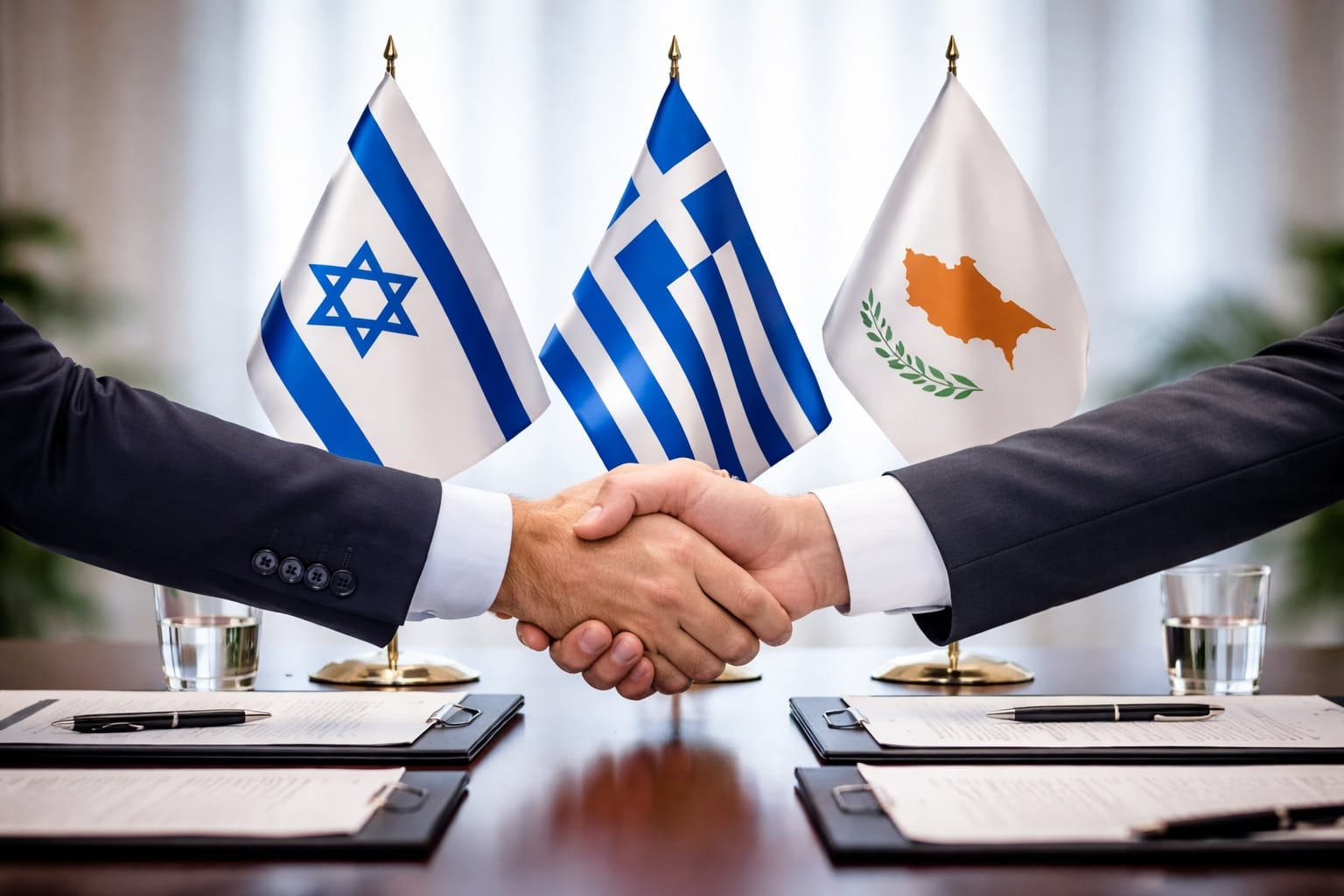
The Eastern Mediterranean has become the centre of a significant geopolitical shift. This change is marked by the recent formalisation of a military cooperation plan between Israel, Greece, and Cyprus. Signed on December 28, 2025, this agreement for 2026 establishes a framework for joint exercises, training, strategic discussions, and crisis response among the three countries, which share strategic interests and regional goals. This pact comes amid ongoing conflict in Gaza and rising tensions with Iran. It signals a clear effort to strengthen a strategic partnership that could affect security and energy dynamics in a volatile region.
The Structure of the New Alliance
The newly signed work plan represents more than just a symbolic gesture; it creates a real military framework. The agreement includes joint exercises, cross-training programs, specialised working groups, and regular military discussions. While it does not establish a permanent standing army, the collaboration seeks to create a rapidly deployable joint force of about 2,500 personnel. This force will be ready to respond to crises on land, sea, or air. The framework is designed for flexibility and quick action.
Defence relationship is further enhanced by significant arms deals. Greece is finalising a major purchase of 36 PULS rocket artillery systems from Israel’s Elbit Systems, worth around $758 million. Cyprus has recently deployed Israel Aerospace Industries’ Barak MX air defence system and is actively seeking more military equipment from Israel to modernise its National Guard. These deals increase reliance on each other and ensure that the forces can work together effectively, even before any training begins.
The Unspoken Adversary: A Unified Front Against Turkey
A key, though often unmentioned, reason for this trilateral cooperation is shared concern about Turkey’s regional policies. All three nations have troubled relations with Ankara, but for different reasons.
- For Greece, long-standing disputes with Turkey over maritime boundaries and airspace in the Aegean Sea remain a top national security issue.
- For Cyprus, the situation is existential, arising from the island’s division since 1974 and Turkey’s support for the Turkish Republic of Northern Cyprus, which only Ankara recognises.
- For Israel, tensions have escalated due to Turkey’s strong political backing of Hamas and criticism of Israeli operations in Gaza, along with a continued Turkish military presence in Syria.
The alliance serves as a strategic counterbalance. During the trilateral summit in Jerusalem on December 22, Prime Minister Benjamin Netanyahu’s remark, “those who believe they can re-establish their empires and dominate our lands, I say forget it,” acted as a clear, though indirect, warning to Ankara regarding its ambitions. The partnership also aligns with broader infrastructure projects like the India-Middle East-Europe Economic Corridor (IMEC), which intentionally avoids Turkey.
Energy, Diplomacy, and Crisis Solidarity
Beyond military and security matters, the partnership is reinforced by shared energy interests and clear political unity. The long-discussed EastMed gas pipeline, while facing financial and technical hurdles, still represents a strategic goal for connecting regional energy resources to Europe. More immediately feasible are projects linking Israeli offshore gas fields directly to LNG facilities in Cyprus, which will enhance energy security and economic ties.
Politically, Greece and Cyprus have distinguished themselves from other European Union members by maintaining a balanced approach toward Israel during the Gaza war and the intense conflict with Iran in June 2025. While many EU states criticised Israel, Athens and Nicosia kept an open dialogue. This unity became apparent during the war with Iran when both countries served as vital hubs for Israeli civilians and aircraft that could not return home, later coordinating “Operation Safe Return” for repatriation.
As Cyprus and Greece prepare to hold the presidency of the Council of the EU in 2026 and 2027, respectively, they can act as key links between Israel and a sometimes-divided Europe.
The Broader Chessboard: Netanyahu’s Parallel Diplomacy
The formation of this Mediterranean alliance aligns with a crucial moment in Israel’s relationship with its main ally, the United States. Prime Minister Netanyahu’s meeting with President Donald Trump at Mar-a-Lago on December 29 occurred amid growing American frustration over a stalled Gaza ceasefire process.
The Trump administration is eager to move to the second stage of its 20-point peace plan, which involves forming a Palestinian technocratic government, deploying an international stabilisation force, beginning reconstruction, and ensuring Hamas’s disarmament. However, Netanyahu’s government has been cautious about withdrawing from the approximately 53% of Gaza it currently controls without guarantees for Hamas disarmament. Some U.S. officials view this as “slow-walking” the peace process. These differences, along with Israeli strikes in Syria and debates over policy toward Qatar, have strained the leaders’ relationship, which now seems based more on mutual necessity than strong alignment.
Netanyahu likely aimed to seek U.S. support or approval for possible preemptive military action against Iran during his visit to Florida. Israel believes Iran is quickly rebuilding its missile and nuclear capabilities after the summer conflict. In this high-stakes situation, the strengthened partnership with Greece and Cyprus serves as a vital strategic advantage, giving Israel more operational depth and regional diplomatic support without solely depending on Washington’s influence.
A Technological Game Changer: The Dawn of Laser Defence
Adding another layer to this complex strategic situation is Israel’s announcement, just one day before Netanyahu’s trip to the U.S., about delivering its first operational “Iron Beam” laser defence system to the Israel Air Force. This advanced laser system, developed by Rafael Advanced Defense Systems and Elbit Systems, marks a significant technological advancement as the first of its kind to become operational.
Having successfully tested against rockets, mortars, and drones, Iron Beam aims to integrate into Israel’s layered air defence network, complementing the Iron Dome, David’s Sling, and Arrow systems. Its revolutionary aspect lies in its cost-effectiveness; once operational, the cost per interception is nearly negligible, fundamentally changing the economics of missile defence against inexpensive, mass-fired rockets.
Defense Minister Israel Katz called the system a game changer that sends a strong message to adversaries from Tehran to Sana’a to Beirut. This technological advancement not only boosts Israel’s defence but also enhances the value of its defence exports and strategic partnerships.
A Lasting Realignment
The 2026 trilateral military work plan represents a key milestone, establishing a new security framework in the Eastern Mediterranean. This agreement arises from current geopolitical tensions with Turkey, backed by shared energy interests and strengthened by political unity tested during crises. For Israel, this alliance with southern European countries offers strategic alternatives and diplomatic influence during a time when its primary relationship with the United States shows signs of strain, and regional threats from Iran and its proxies are significant.
As Cyprus and Greece prepare to lead the EU Council, their partnership with Israel could be crucial in shaping Europe’s future involvement in the Middle East. In a region where alliances often change, this trio grounded in practical military planning and mutual strategic needs, seems built to last.
References
1. Israel, Greece, Cyprus sign 2026 trilateral military plan. The Jerusalem Post.
2. Trump to meet Netanyahu in Florida as focus turns to Middle East issues. BBC News
3. Netanyahu brings a familiar message to Trump, who’s grown wary of Israeli actions. CNN.
4. Israel, Greece and Cyprus Formalize 2026 Military Cooperation. Newsweek.
5. Netanyahu to meet Trump in US amid fears of Israeli regional offensives. The Guardian.
6. ‘Historic milestone’: Iron Beam laser interceptor delivered to IDF. Ynetnews.
7. Israel, Greece and Cyprus: In Search of New Synergies. BESA Center Perspectives Paper.
8. Iron Beam: IDF’s first operational high-power laser defense system. i24NEWS.
All the views and opinions expressed are those of the author. Image Credit: The Viyug.
About the Author
Jaiee Ashtekar holds a bachelor’s degree and a master’s degree in political science from the University of Mumbai. She holds a post-graduate diploma in international relations from the University of Strathclyde, United Kingdom (UK). She has done projects titled “Kashmir through Political Perception” and “Water issues between India and Pakistan.”