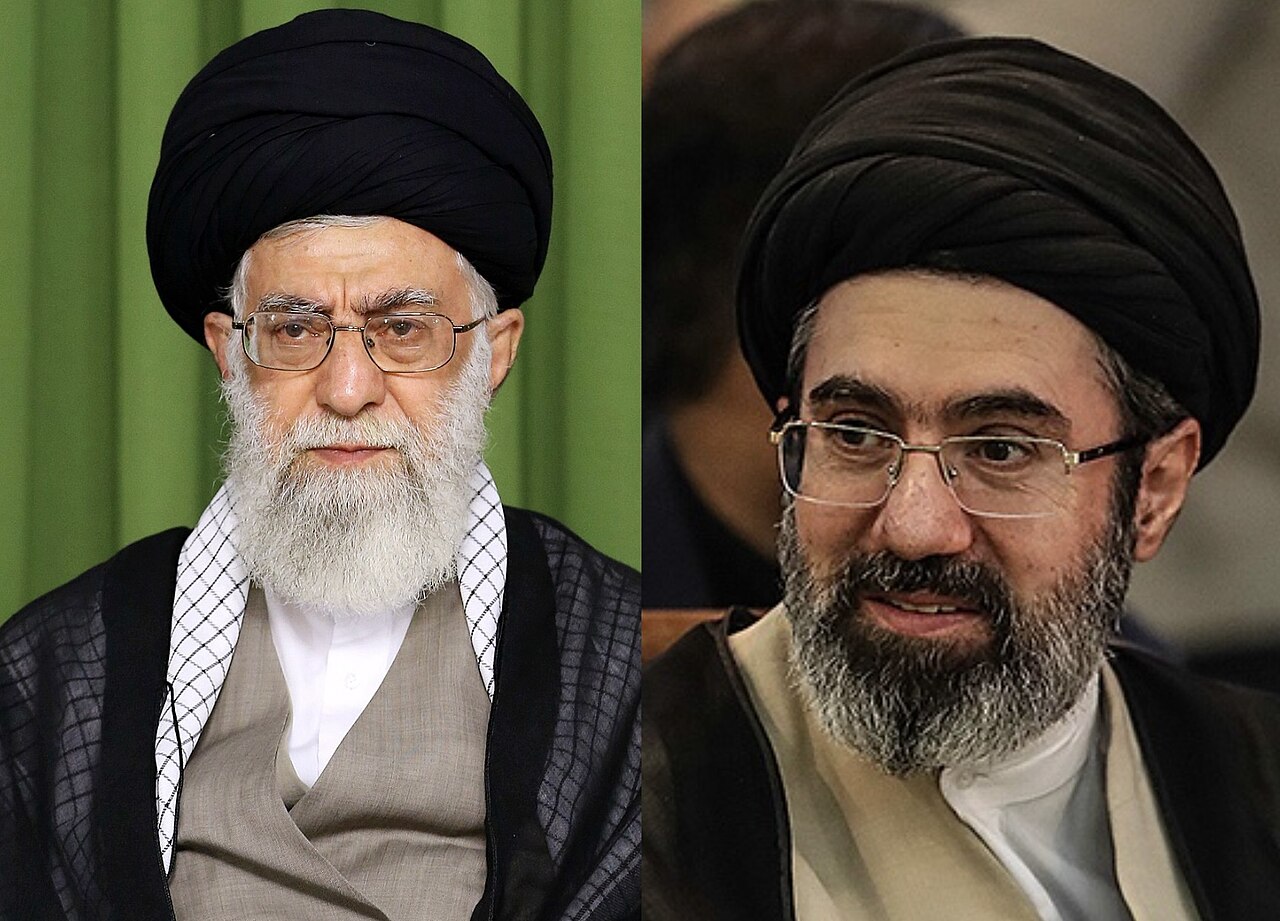
On 12 March 2026, Iran’s state television broadcast what officials described as the first statement from the country’s newly appointed Supreme Leader. Rather than hearing directly from Mojtaba Khamenei, viewers were shown a still image of him while a news presenter read the statement aloud. There was no recorded speech, no live appearance, and no video message. The individual constitutionally designated as Supreme Commander of the Armed Forces, protector of the Islamic Revolution, and earthly representative of the Hidden Imam had not appeared publicly or spoken since his appointment three days earlier.
From its inception, the Islamic Republic has asserted that its authority originates neither from elections nor from military force but from divine legitimacy. The doctrine of velayat-e faqih, the guardianship of the Islamic jurist places ultimate authority in the hands of a senior cleric who is considered the living intermediary between society and the Twelfth Imam. This raises an uncomfortable question: what occurs when the individual occupying that role cannot publicly confirm his presence? Under such circumstances, the ideological framework that supports the system begins to appear fragile. The resulting tension does not arise from Western criticism but from contradictions within the Republic’s own theological and institutional foundations.
The Constitutional Requirements of Velayat-e Faqih
Article 109 of Iran’s Constitution clearly specifies the qualifications required of the Supreme Leader. According to the constitutional text, the Leader must possess:
- Sufficient scholarly expertise to issue fatwas across the disciplines of Islamic jurisprudence (fiqh);
- Demonstrated justice and personal piety necessary for guiding the Muslim community;
- Political awareness, social insight, prudence, courage, and administrative capability
When multiple individuals meet these criteria, the constitution states that preference should be given to the candidate who demonstrates greater expertise in both jurisprudence and political judgment. A constitutional amendment adopted in 1989 lowered the earlier threshold by removing the requirement that the Leader hold the status of marjaʿ or maintain widespread religious following. This change facilitated the appointment of Ali Khamenei despite doubts about his scholarly standing at the time. Even so, Ali Khamenei had previously served as president, held the clerical rank of hojjatoleslam (later elevated), and accumulated decades of experience within Iran’s revolutionary political system.
Evaluated against these standards, Mojtaba Khamenei’s credentials appear considerably more limited. For many years he was regarded as a mid-ranking cleric and was only granted the title of Ayatollah in 2022 after spending much of his career outside the public spotlight. His formal seminary education began relatively late, and he has not produced widely recognised works in Islamic jurisprudence. Furthermore, many senior clerical authorities do not recognise him as a mojtahed. Open-source analyses and occasional inconsistencies in Iranian state media indicate that he continued to be referred to as Hojjat al-Islam until shortly before the leadership succession was announced.
In this context, the constitutional principle that prioritises the most qualified candidate appears difficult to reconcile with the outcome. Several clerics with stronger scholarly reputations including figures associated with reformist tendencies were reportedly excluded from consideration. Consequently, the tension surrounding Mojtaba’s appointment stems not from external propaganda but from the Islamic Republic’s own constitutional and doctrinal standards.
From Assassination to Leadership Transition
Ali Khamenei died on 28 February 2026 following joint United States and Israeli strikes targeting his compound in Tehran. Iranian state media confirmed his death within hours and declared forty days of national mourning. Almost immediately, commanders of the Islamic Revolutionary Guard Corps (IRGC) began exerting pressure on members of the Assembly of Experts. By 3 March, the Assembly convened an emergency session. Instead of gathering in its traditional meeting hall in Tehran, members reportedly participated through secure video connections. Some reports suggested that several members were absent or attended under supervision. No alternative candidates were formally introduced.
Hassan Khomeini; the grandson of the Islamic Republic’s founder and a cleric widely regarded as possessing legitimate scholarly credentials was reportedly excluded from consideration despite earlier speculation about his potential candidacy. Sources cited by Iran International indicated that IRGC officials warned members of the Assembly that opposing Mojtaba Khamenei during wartime would be interpreted as an act of disloyalty.
On 9 March, the Assembly announced that it had selected “Ayatollah Mojtaba Hosseini Khamenei” as the third Supreme Leader of the Islamic Republic. The statement described the decision as decisive, yet the voting process was not broadcast live, no photographic evidence of a quorum was released, and dissenting views were not publicly permitted.
The speed and secrecy surrounding the decision surpassed even the precedent established during the succession of 1989. As a result, observers began asking a politically sensitive question: whether the Revolutionary Guards effectively determined the outcome while the clerical body merely formalised it. In this interpretation, the constitutional procedure functioned more as a symbolic ritual than as an independent decision-making process.
The March 12 Broadcast: Presentation versus Authority
Three days later, state television aired what it called Mojtaba Khamenei’s first official message. A news presenter delivered the text, which called for continued resistance, retaliation for the assassination of his father, the closure of the Strait of Hormuz to American and Israeli shipping, and the rejection of negotiations while foreign military forces remained stationed in the Gulf region. The tone of the statement aligned closely with the hardline rhetoric typically associated with the IRGC.
However, the manner in which the message was delivered weakened its intended impact. Instead of addressing the nation directly, the Supreme Leader appeared only as a static portrait while another individual read the statement. There was no voice recording, no live broadcast, and no visible confirmation that the message had been delivered by him personally.
On the same day, Iran’s elected president, Masoud Pezeshkian, adopted a noticeably different tone during interviews with regional media outlets. He signalled a willingness to consider diplomatic channels and de-escalation. The coexistence of these two positions, an uncompromising message attributed to an unseen Supreme Leader and a conciliatory tone expressed by the visible head of government created the impression of conflicting directions within Iran’s foreign policy. Online observers quickly noted the discrepancy, with hardline commentators emphasising the rhetoric of resistance while others questioned why the country’s highest authority had not addressed the nation directly.
From Clerical Authority to Military Transformation
The current succession may represent the culmination of a gradual institutional transformation. The doctrine of velayat-e faqih originally envisioned a system in which religious scholars maintained ultimate authority over the state. Over time, however, the Assembly of Experts, the body responsible for safeguarding the religious legitimacy of the Leader appears to have become increasingly influenced by the Revolutionary Guards. In this environment, the military establishment protects and enforces the political order while the clerical leadership provides symbolic religious legitimacy.
The contrast with 1989 is particularly striking. Although Ali Khamenei lacked the highest clerical credentials at the time of his appointment, he possessed extensive revolutionary experience and decades of political leadership, including two terms as president. Mojtaba Khamenei, by comparison, assumes power during an active conflict, with limited public political experience and amid persistent uncertainty surrounding his visibility.
The system that once claimed theological authority grounded in religious scholarship now appears to depend heavily on the backing of security institutions. The ideological structure created by Ayatollah Khomeini in 1979 therefore, seems increasingly hollowed out. Rather than selecting the most qualified jurist, the Assembly of Experts appears to have endorsed the preference of the most powerful faction within the state.
Ending Note
This situation raises a fundamental question: can a Supreme Leader who has not appeared publicly and whose scholarly qualifications remain contested maintain the level of religious and political authority envisioned by the Islamic Republic’s founding doctrine?
For now, the answer remains uncertain. Mojtaba Khamenei’s authority is represented primarily through photographs and written statements broadcast by state media, while the Revolutionary Guards enforce internal cohesion and political discipline. At the same time, the practical interpretation of constitutional principles appears to be evolving in response to new political realities.
Although the government insists that the system remains stable and continuous, historical experience suggests that regimes grounded in ideological legitimacy face serious challenges when the symbolic figure at their centre becomes distant or opaque. When the individual meant to embody divine authority cannot visibly demonstrate his presence, the credibility of that authority may begin to erode. The Islamic Republic, therefore confronts a critical test. Whether a political order built upon claims of divine mandate can endure when the person said to embody that mandate remains largely unseen.
All the views and opinions expressed are those of the author. Image Credit: AhmadKermani1979.
About the Author
Jaiee Ashtekar holds a bachelor’s degree and a master’s degree in political science from the University of Mumbai. She holds a post-graduate diploma in international relations from the University of Strathclyde, United Kingdom (UK). She has done projects titled “Kashmir through Political Perception and “Water issues between India and Pakistan”.