The Indian military is recognised as the fourth most potent armed force globally and the recent success of Chandrayaan 3 has cemented India’s status as the fifth great space power. Whereas on the diplomatic front, India’s vaccine diplomacy during the covid-19 pandemic and the role of net security provider in the Indo-Pacific coupled with its leadership of the Global South has affirmed India’s position as a Vishwaguru (teacher to the world) within the international community. According to Morgan Stanley, India stands at the cusp of a transformational decade poised to become the third-largest economy by overtaking Germany by 2028. However, India’s path to great power status remains a Sisyphean task as it grapples with a multitude of internal security challenges.
The 2nd Administrative Reforms Commission report defines Internal security as the absence of armed rebellion, terrorism, or large-scale criminal violence that threatens the integrity of the state and its institutions. However, internal security is a dynamic concept that has organically evolved to span a broader ambit of multidimensional threats such as 5th gen warfare, organised crime, and maritime security in addition to traditional security threats of terrorism and insurgencies. Furthermore, the advent of AI, technological evolution, geopolitical developments and the recent terror attack in Pahalgam have redefined the contours of national security for India.
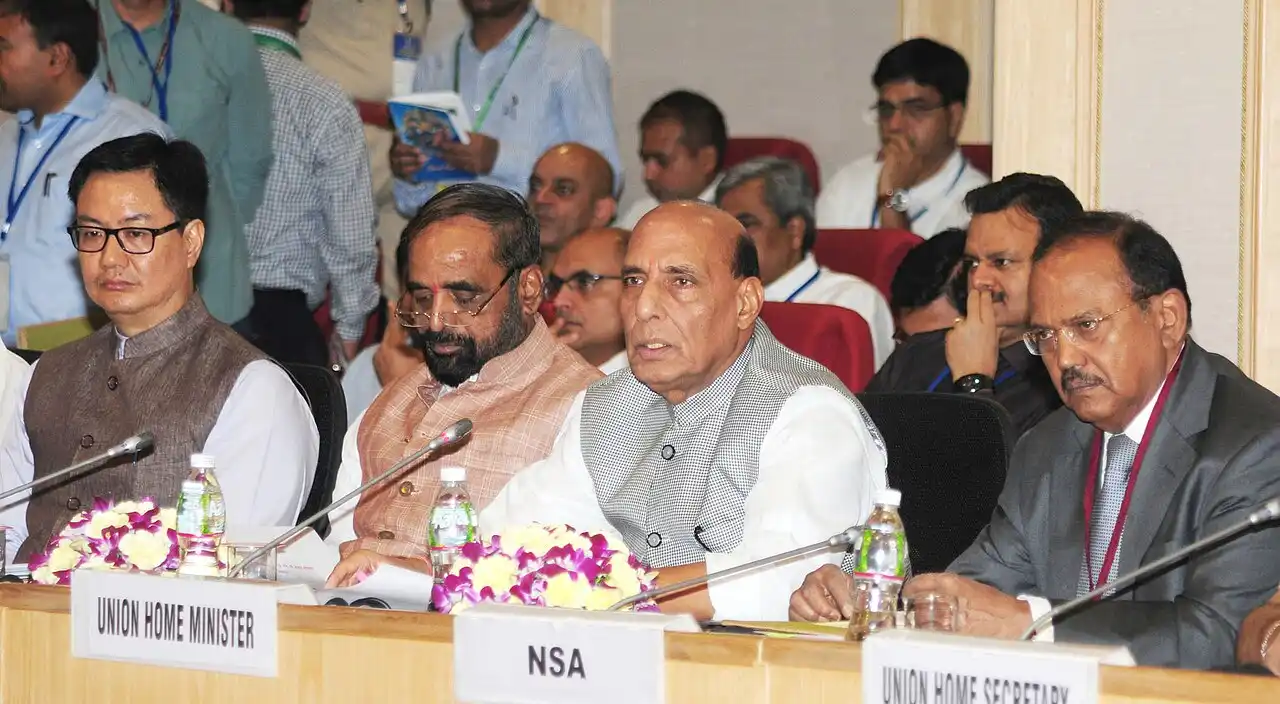
According to NSA Ajit Doval, “You cannot have a great powerful country if you cannot manage its internal security.” Internal security is the backbone of a nation’s sovereignty, integrity and prosperity. Guided by a mix of external, domestic, historical and ideological factors, India’s internal security challenge encompasses a spectrum of multidimensional threats:
1. Left Wing Extremism – Spatial Spread of an Ultra-Radical Maoist Agitation in Tribal Heartlands of India
Left Wing Extremism also known as Naxalism is a form of political violence rooted in the ideology of Maoism. Originating from the Naxalbari movement in 1967 in West Bengal, the movement was fundamentally centred around tribal rights on Jal, Jungle, Jameen (Land, water and forest), lack of development, socio-economic equality and state oppression. It primarily spread across the “Red Corridor,” affecting underdeveloped, tribal dominated regions across 9 states. While the anti-state ideology has persisted, the LWE outfits have turned towards digital and psychological warfare, for ideological outreach, anti-state propaganda, recruitment and financing.
One prominent example is the use of content syndication across multiple Top-Level Domains to evade bans and enhance global visibility of the People’s March magazine that has served as a medium to disseminate LWE ideology since 2003. Furthermore, the weakening of physical stronghold of LWE has resulted in the emergence of Urban Naxalism. Urban Naxalism refers to the phenomenon where urban individuals and intellectuals situated in civil societies, NGOs, academia, and other institutions provide ideological and logistical support to the Naxalite movement.
This radicalises the youth, influences public opinion, and creates unrest under the guise of social justice. It has been predicted that the Digital media coverage of anti-Maoist operations may become polarised, with up to 30 to 40% of articles and blogs originating from urban sympathiser networks pushing the state-as-oppressor narrative. Thus, while there has been 81% reduction in incidents of LWE violence between 2010 – 2024, this statistical drop however, conceals the deeper ideological resilience and adaptation of the movement in the upcoming age.
2. Terrorism and Cross Border Insurgency: Pakistan-backed terrorism and secessionist politics in Jammu and Kashmir, cross-border insurgencies in the North East and the China factor in destabilising regional politics
In Jammu and Kashmir, historical grievances, alienation of the local populace due to AFSPA, limited connectivity and lack of economic integration along with interference from Pakistan created a fertile ground for militancy and radicalising the youth. While most of the previous terror attacks in the valley primarily targeted the armed forces, this trend has been changing with the recent attacks on civilians. The recent terrorist attack in Pahalgam explicitly targeted civilians and set a communal undertone to violence by differentiating them on the basis of religion. Additionally, while the number of local recruits have dropped, meticulous monitoring remains imperative as foreign militants fill the terror vacuum.
Furthermore, the rapid evolution of technology has enabled secure communications, remote weapons supply, logistic support, surveillance and precision targeting exacerbating traceability. It has been widely acknowledged that Chinese communication tools, including banned Huawei satellite phones and encrypted messaging apps, have helped the terrorists evade detection by establishing secure communication lines with their handlers across the border while drones are being used for logistics supply and smuggling weapons. These trends reflect a major shift from traditional guerrilla tactics to digitally-enabled, high impact, operations. Thus, the security forces face emerging challenge of countering tech-driven subterfuge along with traditional threats.
Presence of numerous tribes, their longstanding religious and ethnic rivalries, porous borders, narrow connectivity, infrastructural and developmental deficit and China have resulted in constant socio-political turmoil in the North Eastern States. In the North East, particularly in Manipur, the 2023–24 ethnic violence, has resulted in over 250 deaths and displacement of 60,000 people, reflecting how internal ethnic fault lines can trigger large scale instability. The rampant misuse of technology such as surveillance drones, digital echo chambers and deepfakes reflect emerging security threats in maintaining law and order.
Govt fact-checking units flagged over 2,000 posts in 2023 as fake news related to Manipur. Cascading effect of Chinese interference and the ongoing civil war in Myanmar that has enabled the return of trained insurgents into India, has fuelled ethnopolitical unrest, particularly between Meitei and Kuki communities. China’s tacit support to insurgent groups via Myanmar, and its aggressive posture along the LAC, especially in Arunachal Pradesh, introduces an emerging geopolitical dimension to India’s internal security concerns.
3. Political Polarisation on Socio-Economic Differences and Communal Violence on Ethnic Fault Lines
Prior to the 2000’s instances of communal violence were highly episodic, triggered by significant events such as the 1992 Babri Masjid demolition, Godhra riots triggered by the Ayodhya Ram Temple dispute, etc. whereas the post 2010 phase saw the rise of identity-based politics, and increasing political alignment along religious and caste lines. This marked a shift from sporadic violence to structural violence. A prominent example is the Bhima Koregaon riots of 2018 which spiralled into caste-based violence reflecting diverging ideological visions of India – Dalit assertion versus dominant caste nationalism.
Adding to the mix is the information warfare and radicalisation by digital echo chambers that create ideological silos prompting religious extremism and hyper nationalism which was recently seen in the Nagpur riots in March 2025. Thus, as electoral politics have been acquiring communal undertone, communalism is set to emerge as a continuous rather than periodic feature of electoral landscape. This evolution poses significant threats to democratic cohesion, policy neutrality, and internal security.
4. Secessionist tendencies – A Violent Campaign for an Independent Khalistan in Punjab and Separatist Demands in the North East
Stemming from a combination of ethnic, religious, linguistic, local and historical grievances, secessionist tendencies in India are often exacerbated by external interference, developmental neglect, and political alienation. Such tendencies have been historically significant in Punjab where the Khalistan movement, demands a separate Sikh homeland and the North East India where several ethnic and tribal groups have sought regional autonomy or outright independence at various points.
The Khalistan movement originated in the 1980-90s, rooted in Punjab’s socio-political and religious alienation. While the movement eventually went dormant domestically, its offshoots were survived by the Indian diaspora in Canada, UK, and the US which has led to a considerable diplomatic strain in relations with counterparts like Canada and the US.
In the North East, multiple armed movements have been driven by the demands for Greater autonomy (e.g., Bodos, Kukis), separate statehood (e.g., Gorkhas, Karbis), and complete secession (e.g., NSCN for Nagaland, ULFA for Assam). The recent MHA Annual Report (2023) shows that there has been a 76% decline in insurgency incidents in the North East since 2014, but ethnic conflict and foreign interference remain active concerns.
Emerging threats stemming from these movements include Youth radicalisation, merging of ideology with local criminal gangs and narco networks and greater percolation of organised crime syndicates. Diplomatic strain due to civil rights activism and the existence of cross-border safe havens for separatist leaders in countries like Myanmar, Bangladesh, and China’s alleged tacit support to certain groups introduces a diplomatic angle to the issue.
5. Strained Centre-State Relations and Regional Autonomy
A greater centralising tendency has been observed in Indian federal system since the inception of GST council and NITI Aayog in 2015. Systemic neglect of regional development, aspirations and increasing socio-economic disparities result in demands for greater regional autonomy, linguistic chauvinism and preferential public policies for sons-of-the-soil as seen in Local Job Reservation Bill of Karnataka and Marathi language row in Maharashtra.
Balancing regional development and aspirations with national interests will require a careful and collaborative approach and is integral to the internal security of India.
6. 5th Gen Warfare
The rapid advancements in technology have shifted the battlefield from traditional physical domains to the cognitive and cultural realms, targeting perceptions, influence and behaviours. Fifth Generation Warfare (5GW) also known as Invisible or silent warfare is a form of warfare that primarily deploys non-kinetic military actions encompassing social engineering, misinformation, cyberattacks, and emerging disruptive technologies like AI and autonomous systems in war tactics.
Recently, as military tensions among India and Pakistan soared, conflict escalated to the cognitive domain where India became a target of incessant cyber-attacks and misinformation campaigns. Multiple Pakistan linked groups claimed over as much as 100 cyberattacks on Indian government, education, and critical infrastructure websites. One of the Pakistani hacker groups, the Pakistan Cyber Force has claimed to have breached sensitive data from defence institutions compromising the credentials and personal information of defence personnel. According to a report by the Economic Times, the group has alleged that it exfiltrated over 10 GB of data flagging concerns over identity theft of military personnel.
As we move towards an era of greater technological integration, disinformation and deepfakes emerge as law and order concerns whereas data monopoly, identity theft raise concerns over data privacy. Narrative engineering by the weaponisation of social media and cyberattacks further pose threats to the security of India’s digital infrastructure while the nexus of tech aided organised crime and economic offences remains a grave concern.
Ending Note
George Santayana famously pointed out that “those who cannot remember the past are condemned to repeat it.” India as a nation should take a lesson from history and put in place a system that is perspective in nature and capable of dealing with predictable and unpredictable security challenges.
There is no doubt that expecting omnipresence of the security forces or omniscience of the intelligence, is irrational. However, the recent attack in Kashmir has indeed provoked questions on the credence of India’s security and intelligence networks. While there remains an impulsive urge in political circles to play the blame game and contemplate what went wrong, a focus shift to what should not go wrong is necessary. Hence, it is incumbent to acknowledge lapses in security and intelligence frameworks.
The incident warrants the deployment of a stronger security grid in the country – the one that entails meticulous monitoring supplemented by area domination patrols to restrict infiltration and map out not only threats but also eerie silence, suspicious absences and extant vulnerabilities. This will help establish a pervasive presence of our security forces. Furthermore, strengthening HUMINT is essential to gather ground intel and pre-empt attacks. Additionally, tighter border fencing, technological upgrades, a swift targeted response measure and contingency plans are necessary.
Incidents of threats and violence create an environment of fear and hostility which furthers communal dissonance making it easier for terrorists to manipulate and brainwash the individuals into serving their malicious agenda. It is also necessary to acknowledge the social and economic ruin of our brethren in the conflicted regions. Having borne the brunt of terrorism for decades, they equally demand peace and justice as every other Indian.
Rather than communal dissent, let communal amity and national unity take stage echoing greater social cohesion that reverberates the narrative of Akhand Bharat. Let us not play into the hands of these malicious terrorists and give them the satisfaction of dividing us on socio-religious fault lines. Prioritising integration over isolation will directly render failure to the evil designs of the perpetrators.
Furthering connectivity and infrastructure, establishing robust people to people ties and deeply entrenching civil society networks at the grass root level will give India an unparalleled edge in percolating developmental efforts and rapidly integrating vulnerable regions with the rest of the country. Rapid responses to reassure citizens to re-establish confidence in the region is an urgent need.
In this age of globalisation, public perception has become a crucial component that influences conflicts in myriad ways. While the government has taken commendable steps to crush propaganda, most of the mouthpieces of foreign state have repeatedly misreported Indian territories as parts of Pakistan or China and have mellowed down incidents of inimical activities by downplaying their gravity.
Such misinformation propagates false narratives amongst populace abroad and might help shape public perception contrary to India’s national interests. A louder media presence, active participation of citizens, civil societies, think tanks and NGOs is required to counter any anti-India narratives and register a strong protest. However, having said that, social media jingoism should not be encouraged either. Media warriors and crude jingoism can do much more harm than good in such delicate situations.
In this era of soldier less warfare, that primarily revolves around information and cyberspace, it is also important to have a robust cybersecurity framework that priorities data privacy and security. Rolling out Digital India Act and strengthening cyber defence infrastructure remains crucial. Furthermore, ensuring holistic development, employment generation and effective implementation of policies like Forest Rights Act will help fulfil regional and local aspirations and mitigate grievances thereby prompting greater social cohesion. Grievance redressal will also help in channelling discontent towards productive consultation and help prevent radicalisation.
Today, New Delhi is a formidable power with a wide spectrum of options ranging from diplomatic to military tactics in its arsenal to combat security threats. A well calculated and commensurate response to emerging security threats is thus the necessity of the hour to serve as a cautionary tale to prevent repeating the errors of yore.
References
1. 2nd Administrative Reforms Commission Report.
2. “Hard-to-crack Chinese devices part of J&K terror toolkit.” The Economic Times, Feb 2025.
3. “2023–2025 Manipur Violence.” Wikipedia.
4. Press Information Bureau (PIB), Govt of India.
5. “Is India facing a new kind of militancy in Kashmir?” DW News, 2024.
6. “Internal Security Challenges in India.” Indian Century.
All the views and opinions expressed are those of the author. Image Credit: Government of India.
About the Author

Ipsha Bhalsagar is a recent Electronics and Telecommunications engineering graduate with a strong passion for geopolitics and international relations. She has contributed to platforms like The Indian Netizens and Project Statecraft, and the Indian Forum for Public Diplomacy. Ipsha’s work explores the intersection of technology and global affairs, with a focus on strategic analysis and data-driven insights. Her article on India’s maritime security was published in the Phadke Journal of Strategic Studies. She also writes occasionally on her website, sharing her thoughts and opinions.


5 thoughts on “Evolving Dimensions of India’s Internal Security”