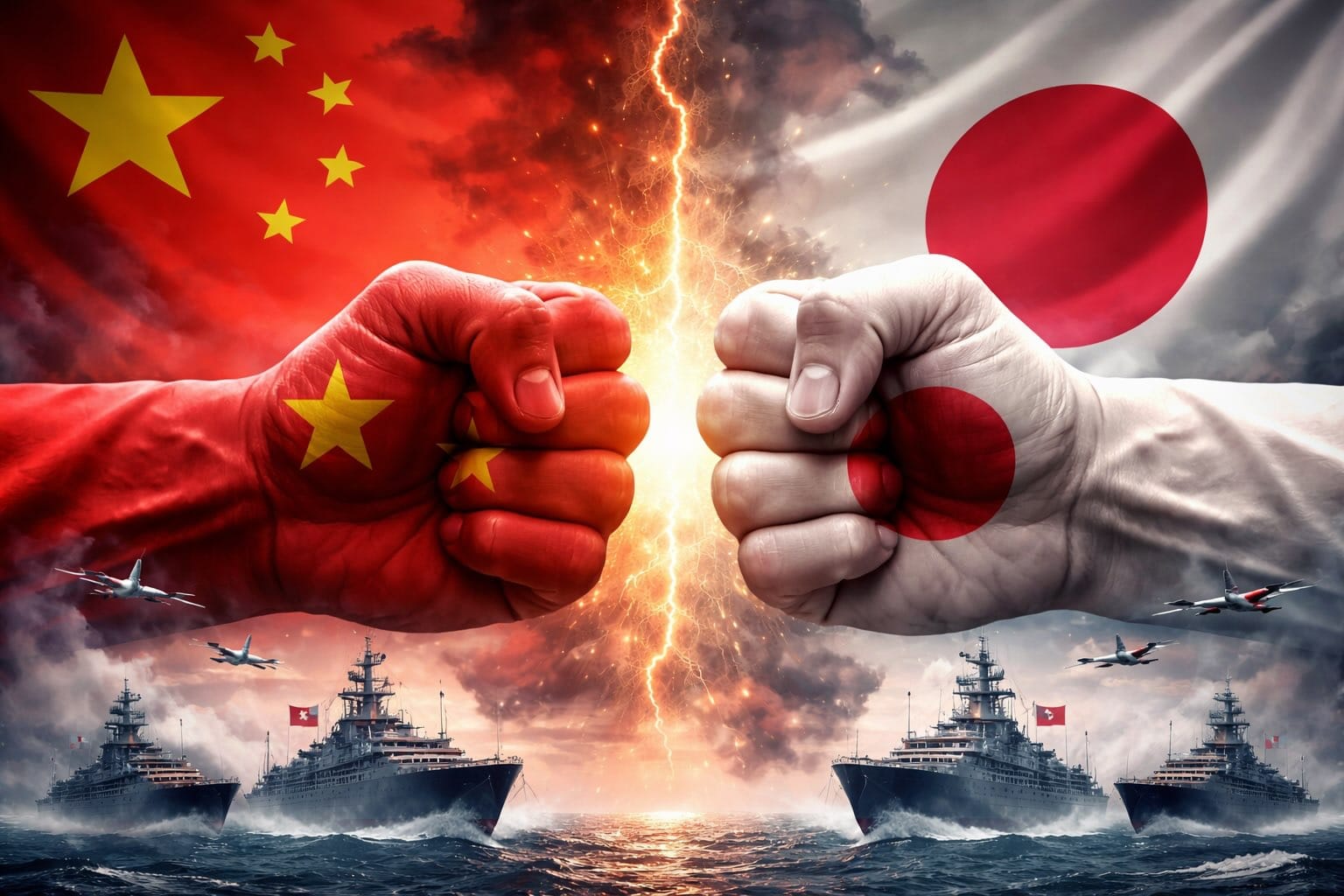
In the icy waters southeast of Okinawa, a Japanese F-15 pilot’s cockpit alarm issues a serious warning. A Chinese J-15 fighter jet has locked its fire-control radar onto the aircraft, a modern equivalent of pointing a loaded gun. In Tokyo, officials urgently summon the Chinese ambassador. In Beijing, state media threatens “severe consequences.” This incident on December 7, 2025, was not an isolated near-miss. It marked the latest and most concerning trigger in a diplomatic crisis that has pushed Asia’s two biggest powers to the brink of conflict, a situation both deny wanting but seem unable to escape.
The tension ignited not over a barren rock in the East China Sea, but through remarks made in Japan’s parliament about an island 160 kilometres away: Taiwan.
A Tinderbox of History and Geography
The current crisis is explosive because it taps into multiple layers of historical grievance and geopolitical ambition. At its core lies the long-standing rivalry for regional dominance, heavily influenced by Japan’s 20th-century imperialism and China’s “century of humiliation.” This historical tension now fuels two significant disputes.
First is the territorial dispute over the uninhabited Senkaku (Diaoyu) Islands, controlled by Japan but claimed by China. For over a decade, China has steadily increased its presence in these waters, sending coast guard vessels to test Tokyo’s determination. These confrontations are a constant low-grade stress in the relationship. Second, and more crucial, is the existential question of Taiwan. Beijing sees the island as a breakaway province and has not ruled out using force. For Japan, Taiwan is more than just a neighbour; it is a critical strategic linchpin since nearly 90% of its oil imports pass through nearby waters. The security of the Taiwan Strait is literally a matter of survival for Japan.
The Tripwire: Words that Changed Everything
The fragile balance shattered on November 7, 2025, when Japan’s new Prime Minister, Sanae Takaichi, spoke to a parliamentary committee. In response to a hypothetical situation, she stated that a Chinese naval blockade or attack on Taiwan would pose a “survival-threatening situation” for Japan. Under Japan’s revised constitutional framework, such a statement could legally trigger collective self-defence, allowing Japanese forces to theoretically intervene alongside allies like the United States.
China viewed this as crossing a line. Takaichi’s remarks were condemned as a “blatant intervention into China’s domestic affairs” and a serious violation of the One-China principle. While her statement wasn’t new—echoing the views of her mentor, Shinzo Abe—its blunt delivery during an official Diet session marked a significant shift from strategic ambiguity. It turned a long-held strategic position into an explicit public threat.
The Spiral: From Diplomacy to Deterrence
China’s response was swift and multi-faceted, intended to impose significant costs. It suspended Japanese seafood imports, issued travel warnings, and restricted cultural exchanges. However, the response soon escalated beyond economic measures into military and diplomatic actions.
The Radar Lock: The December 7 incident, where Chinese aircraft allegedly locked radar onto Japanese fighters, represented a dangerous escalation in signalling. Such an action is one of the most provocative in peacetime, greatly increasing the risk of a deadly miscalculation.
The Missile Archipelago: At the same time, Japan moved to strengthen its defences. Defense Minister Shinjiro Koizumi confirmed the deployment of medium-range surface-to-air missiles on Yonaguni Island, located just 110 kilometres from Taiwan. Tokyo frames this as a necessary measure to “lower the chance of an armed attack.” In Beijing’s view, it is a hostile act that places offensive capabilities near its borders, fuelling a narrative of Japan openly aligning with the U.S. and Taiwan against China.
The Historical Revanchism: Perhaps most worryingly, Chinese commentators and state media have begun to revive historical narratives questioning Japan’s sovereignty over the Ryukyu Islands, which include Okinawa. This marks a dangerous broadening of the dispute’s scope, challenging Japan’s post-war territorial integrity.
The Geopolitical Vacuum
This crisis unfolds in a precarious geopolitical environment. The United States, Japan’s treaty ally and traditional guarantor of regional stability, is an unpredictable player. The Trump administration’s “America First” stance and its transactional view of alliances have created significant uncertainty in the US-Japan security agreement. While the U.S. ambassador to Japan has expressed support regarding the radar incident, President Trump himself has notably remained quiet, reportedly focused on trade discussions with Beijing. This ambiguity invites testing from China and heightens anxiety in Tokyo, pushing Japan to adopt more unilateral, aggressive defence strategies.
Domestically, Prime Minister Takaichi has emerged stronger from this standoff. Her approval ratings have surged to around 75% as the public rallies behind a leader viewed as standing firm against Chinese pressure. This political reality offers her no incentive to back down, locking both nations into a cycle of action and reaction.
On the Brink
We are now facing a “security dilemma,” where one nation’s defensive action is seen as a threat by the other, prompting counteractions. The region, as the Asia Times warned, is “one miscalculation away from confrontation.” The factors for disaster are all present: crowded airspace and waters near Taiwan and the Senkakus, advanced weapons systems on high alert, nationalist sentiments on both sides, and a breakdown in diplomatic channels.
The question is no longer if a conflict between China and Japan could happen, but how it might begin. A collision between coast guard ships near the Senkakus leading to casualties. An accidental engagement between fighter jets after a radar lock. A misstep during a Chinese military drill that Japan interprets as the start of a blockade. Any of these scenarios could trigger a chain reaction, drawing in the United States and disrupting the global economy.
Ending Note: The Question of Our Time
The crisis of December 2025 highlights a tragic paradox. China and Japan are deeply interconnected, linked by supply chains, trade, and investments that have fostered decades of prosperity. Yet their strategic distrust is now absolute. They find themselves trapped in a grim logic where preparing for war makes war more likely.
The path forward requires diplomatic efforts to step back from the brink. This involves quiet discussions, confidence-building measures, and restoring communication hotlines for crisis management. However, with domestic politics in both countries driving confrontation and the regional security framework under stress, the motivation for de-escalation is lacking.
As the world observes, the ultimate question looms over the East China Sea and the Taiwan Strait: have the Dragon and the Rising Sun, tied by history and geography, created a rivalry from which there is no peaceful way out?
All the views and opinions expressed are those of the author. Image Credit: The Viyug.
About the Author
Jaiee Ashtekar holds a bachelor’s degree and a master’s degree in political science from the University of Mumbai. She holds a post-graduate diploma in international relations from the University of Strathclyde, United Kingdom (UK). She has done projects titled “Kashmir through Political Perception” and “Water issues between India and Pakistan.”