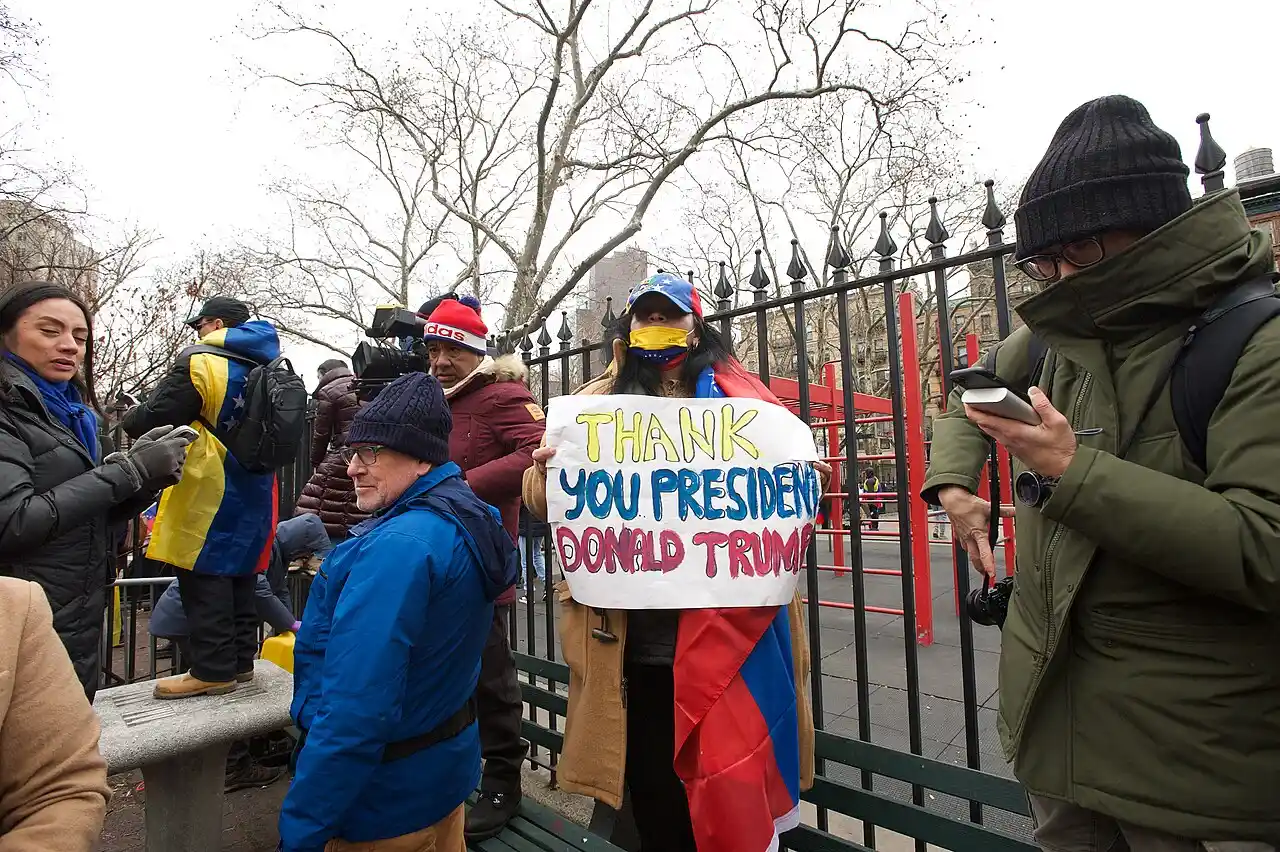
In the early hours of January 3, 2026, more than 150 U.S. military aircraft launched from bases across the Western Hemisphere, converging on Caracas. By dawn, Venezuelan President Nicolás Maduro was aboard the USS Iwo Jima, bound for New York to face narcoterrorism charges. The operation, codenamed “Absolute Resolve,” represented the most audacious military action against a foreign head of state since the 1989 Panama invasion. But unlike traditional warfare, this operation unfolded under a different legal banner entirely: law enforcement.
U.S. President Trump framed the seizure as executing an arrest warrant, not an act of war. This characterisation raises a fundamental question about the evolving relationship between international law and executive power: What legal categories were stretched, redefined, or bypassed to transform a sitting president into a criminal defendant?
From Interstate War to Transnational Enforcement: The Criminalisation of Sovereignty
The Venezuela operation marks a decisive shift in how powerful states justify extraterritorial force. Rather than declaring war against another nation, the United States criminalised its head of state. Maduro had been under federal indictment since 2020 on charges of conspiring with Colombian guerrillas to flood the United States with cocaine. By treating Maduro not as a foreign leader but as an indicted drug trafficker, the Trump administration recast military invasion as law enforcement action.
This reframing is legally strategic. Under international law, using military force against another sovereign state violates Article 2(4) of the UN Charter, which prohibits the threat or use of force against the territorial integrity of any state. The narrow exceptions such as self-defence or Security Council authorisation, clearly do not apply here. Drug trafficking, even state-sponsored, does not constitute an “armed attack” sufficient to trigger the right to self-defence. Yet by indicting Maduro under domestic criminal law, the administration created what it claims is a different legal pathway: the execution of an arrest warrant supported by military protection.
This distinction between “war” and “law enforcement” is not merely semantic. It represents a fundamental recategorisation of international relations. International law distinguishes between prescriptive jurisdiction—the power to pass laws and enforcement jurisdiction—the power to arrest. While the United States can claim jurisdiction over drug crimes that affect its territory, this prescriptive authority does not grant the right to enforce that jurisdiction through coercive means on another state’s soil without consent. Operation Absolute Resolve collapsed this distinction.
By deploying Delta Force operators and 150 aircraft to execute what was nominally a law enforcement function, the United States asserted that criminal indictments can authorise what would otherwise constitute an illegal use of force.
The selectivity of this approach seems like the United States maintains this enforcement posture only against states it deems hostile or weak. As legal scholars note, no similar operation would be contemplated against leaders of nuclear-armed states or close allies, regardless of criminal allegations. This reveals how legal categories adapt under power pressure: international norms are invoked when convenient and bypassed when expedient. The Maduro operation thus establishes a precedent that indictments against foreign leaders can serve as justification for military force but only when the target lacks sufficient power to resist or retaliate.
Other Related Articles Offering In-depth Perspectives
Connecting Foreign Action to Domestic Constitutional Erosion
The international law violations are mirrored by domestic constitutional concerns. The U.S. Constitution assigns Congress the sole power to declare war. Yet the Maduro operation proceeded without congressional authorisation. White House Chief of Staff Susie Wiles had stated in November that land strikes in Venezuela would require congressional approval, saying “if he were to authorize some activity on land, then it’s war, then we’d need Congress.” Two months later, the administration reversed course without explanation.
The official justification rests on an expansive reading of Article II of the Constitution, which designates the president as Commander in Chief. Secretary of State Marco Rubio argued that because this was “not an invasion” but rather “a law enforcement function,” congressional approval was unnecessary. The Pentagon’s role was merely to protect FBI personnel executing the arrest warrant from Venezuelan air defences. This framing employs a legal manoeuvre that treats massive military force as merely ancillary to a civilian law enforcement action—what one legal scholar called the epitome of bootstrapping.
The constitutional architecture that supposedly constrains presidential war-making power has been gradually eroded through this precise mechanism: redefining military operations as something other than war. The administration relied on a controversial 1989 Justice Department memo authored by then Assistant Attorney General William Barr, which concluded that the president has inherent constitutional authority to order the FBI to make extraterritorial arrests, even when doing so violates international law. Under this theory, military force becomes permissible as “unit self-defence”—protection for those FBI personnel on the ground.
This interpretation of Article II authority represents a significant expansion of executive power. Presidents have long claimed inherent authority to use force to protect American personnel abroad. But as constitutional law experts point out, sending personnel into a hostile foreign territory specifically so they can then be “protected” by military force transforms protection into pretext. It converts Article II from a defensive power into an offensive one, limited only by the executive’s willingness to issue an indictment and deploy law enforcement officers.
The implications extend far beyond Venezuela. If a federal indictment combined with nominal FBI presence can authorise large-scale military operations without congressional approval, the war powers have effectively migrated from the legislative to the executive branch. Senator Tim Kaine warned that this precedent could justify future unilateral actions: “Will the President deploy our troops to protect Iranian protesters? To seize Greenland or the Panama Canal?” The mechanism is now established: indict, deploy FBI personnel, provide military “protection,” and bypass Congress entirely.
The Globalisation of U.S. Criminal Jurisdiction
Maduro’s capture represents the culmination of a decades-long expansion of extraterritorial arrest logic. The legal foundation traces to the Ker-Frisbie doctrine, established by the Supreme Court over a century ago, which holds that unlawful abductions do not defeat criminal jurisdiction. Under this doctrine, if U.S. authorities can physically bring a defendant before a federal court, the court may try them regardless of how they were seized. This principle was reinforced in the prosecution of Manuel Noriega, the Panamanian leader captured during the 1989 U.S. invasion. Federal courts held that Noriega’s capture violated international law but proceeded with his trial anyway, treating the manner of arrest as irrelevant to domestic criminal proceedings.
This creates a peculiar asymmetry in American jurisprudence. International law violations that occur during an arrest are deemed non-justiciable—beyond judicial review—in subsequent criminal trials. Courts have consistently refused to dismiss prosecutions based on illegal captures, treating questions of international law as matters for the political branches rather than the judiciary. The practical effect is to eliminate any domestic legal check on extraterritorial enforcement actions. Once a defendant is in custody, the legality of the capture becomes moot. This framework transforms criminal law into a foreign policy tool of remarkable flexibility. As one legal analysis notes, the distinction between jurisdiction to prescribe and jurisdiction to enforce has collapsed in practice.
The United States asserts broad prescriptive authority over conduct that affects its territory—drug trafficking, sanctions violations, financial crimes and more. It then treats that prescriptive jurisdiction as conferring enforcement authority anywhere its military can reach. The result is a unilateral system of global criminal jurisdiction backed by military force.
The Maduro case crystallises this evolution. A domestic indictment from the Southern District of New York, based on allegations of narcoterrorism, served as the legal predicate for a military operation involving airstrikes, special forces raids and the forcible abduction of a sitting head of state. The operation was justified domestically as law enforcement and internationally as either self-defence or simply ignored. Neither framework withstands scrutiny, but both provide sufficient legal cover for executive action.
This instrumentalisation of criminal law serves strategic objectives beyond the immediate prosecution. The United States has used indictments to delegitimise adversarial leaders, offering rewards up to $50 million for information leading to Maduro’s capture https. These reward programs create economic incentives for defection and destabilisation. The existence of an indictment provides diplomatic leverage and justification for sanctions. And ultimately, as Venezuela demonstrates, the indictment provides the legal architecture for military intervention. Criminal law has become a multi-purpose tool of statecraft, deployed not primarily to secure convictions but to advance geopolitical goals.
The UN Secretary-General warned that the operation “constitutes a dangerous precedent” with “worrying implications for the region.” The concern is not merely about Venezuela but about the erosion of the prohibition on unilateral force that has underpinned international order since 1945. When powerful states can bypass that prohibition by criminalising foreign leaders and framing invasions as arrests, the entire system of sovereign equality collapses into hierarchy. International law becomes something that constrains the weak while the powerful operate under different rules.
Ending Note
The legal architecture surrounding the Maduro operation reveals how thoroughly foundational principles have been reshaped by executive practice. What began as a narrow exception for law enforcement has expanded into a sweeping justification for military force. What began as prescriptive criminal jurisdiction has metastasised into global enforcement authority. What began as Article II protection authority has transformed into offensive war-making power.
The operation succeeded tactically but failed to provide any coherent legal justification. Instead, it demonstrated that when a sufficiently powerful state decides to act, legal categories can be redefined retroactively to accommodate that action. The prohibition on the use of force becomes a “law enforcement operation.” Congressional war powers become unnecessary when the operation is framed as protecting FBI personnel. International sovereignty becomes subordinate to domestic indictments.
UN officials, international law scholars, and even some U.S. lawmakers have condemned the operation as a clear violation of established legal principles. But these condemnations cannot reverse the precedent now established. Future administrations will cite the Maduro operation when seeking to justify their own extraterritorial enforcement actions. Each unchallenged episode becomes authorisation for the next, normalising unilateral force through repetition rather than legal reasoning.
The Venezuela operation forces a reckoning with a question international law has struggled to answer: What happens when the most powerful states simply refuse to be bound by rules they find inconvenient? The answer, increasingly, is that those rules adapt to accommodate power. Legal categories stretch. Precedents accumulate. And the gap between the formal structure of international law and the actual practice of powerful states continues to widen. The Maduro capture did not break international law so much as it revealed how thoroughly that law has already been subordinated to the strategic calculations of those strong enough to act with impunity.
Featured Image Credit: SWinxy.
About the Author
Mansi Suryavanshi is a research consultant for The Viyug. She has developed expertise in paralegal services and research work related to judgements for assisting legal work. She previously worked as an assistant professor at the Department of Physics in PG College.
One thought on “How Criminal Law Became a Tool of U.S. Foreign Policy in Trump’s Maduro Operation”