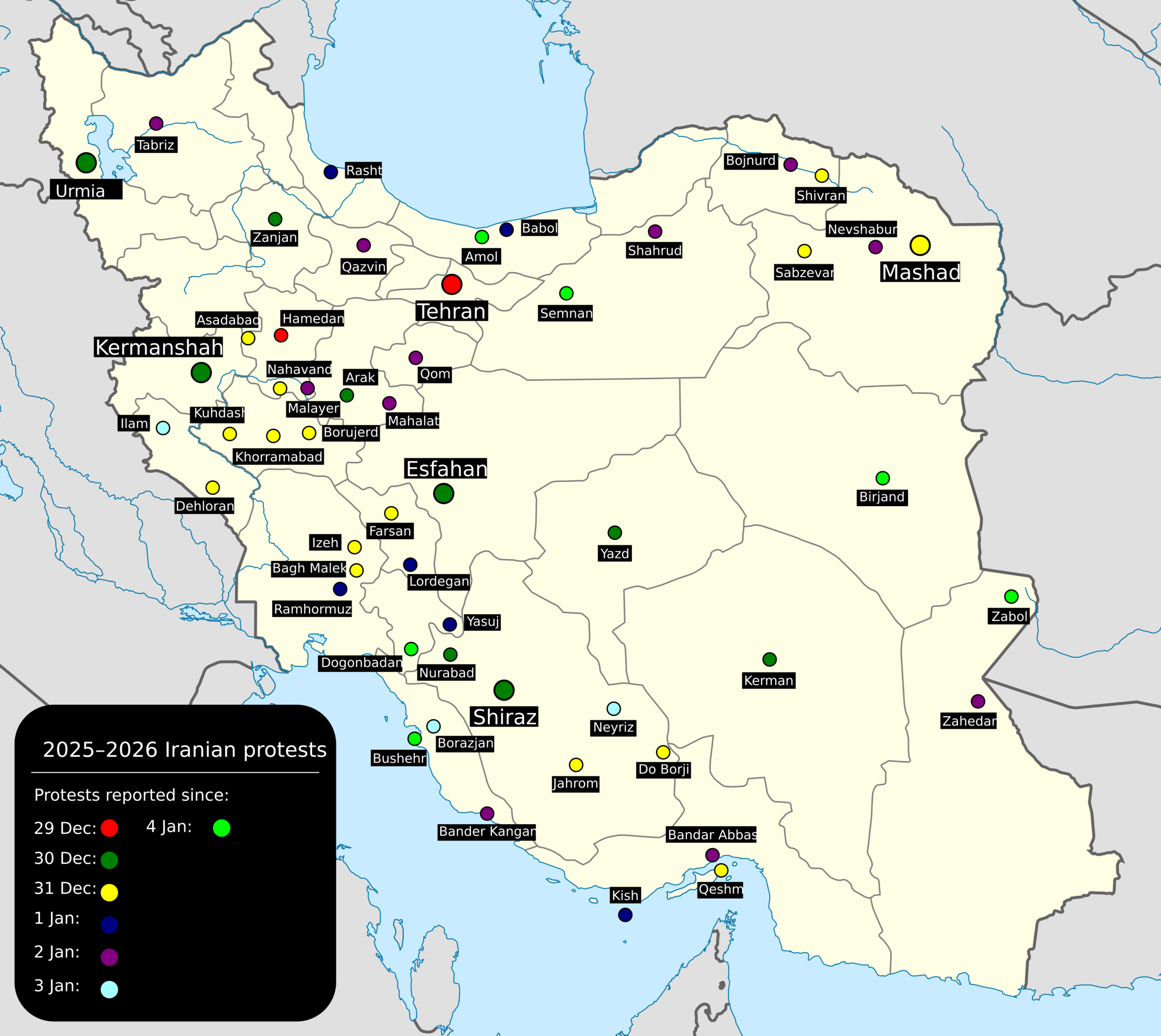
Since the last week of December 2025, Iran has seen its largest uprising in years. The immediate cause was the collapse of the national currency, the rial. Shopkeepers in Tehran’s Grand Bazaar shut their stores in protest, sparking a nationwide demand for political change. What started as an economic complaint quickly escalated into a direct challenge to the theocracy. The unrest spread to at least 78 cities and over 200 locations by early January 2026. This movement, met with harsh repression, has tested the regime’s stability.
From Currency Crash to Political Chants
The unrest was clearly driven by economic factors. After the reinstatement of UN sanctions in late September 2025, the Iranian rial fell to a record low of 1.42 million to the US dollar. This rendered people’s savings worthless and made basic goods unaffordable for millions. Protests began among shopkeepers and mobile phone sellers in Tehran on December 28. This group, usually supportive of the clerical regime, revealed a significant fracture in its foundation.
Within days, the protests grew. University students joined in. Calls for economic relief turned into political chants like “Death to the dictator” and “Pahlavi is coming back,” referencing the exiled son of Iran’s last king. This rapid change shows that many see the economic crisis as a symptom of deeper governance failures. Protesters are not just seeking assistance; they are linking their financial struggles to the political system, chanting, “This nation will not be a nation until the mullahs are buried.”
Government’s response has involved overwhelming force and narrative control. Supreme Leader Ayatollah Ali Khamenei distinguished between legitimate “protesters” and violent “rioters,” pledging to handle the latter with strength. In the streets, this rhetoric led to severe violence from security forces and the Basij paramilitary. Human rights groups reported that by early January 2026, at least 20 protesters had been killed, including three children.
One incident involved Mostafa Falahi, a 15-year-old shot by security forces in Azna on January 1. In Ilam, security forces reportedly raided Khomeini Hospital, attacking injured protesters seeking safety there. The government confirmed “targeted arrests” of those labelled as “leaders” inciting unrest. Critics argue that these are tactics to force confessions and blame foreign interference.
Illuminating a Closed Society
Iran’s restricted media environment limits access to official information. In this context, gathering and analysing available information becomes essential. Open Source Intelligence (OSINT) analysts combine social media videos, user-generated videos, satellite images and geolocation tools to understand ongoing events in Iran including movements of security forces. Footage featuring specific vehicles or uniforms helps verify locations and identities. Reports of targeted internet shutdowns in protest areas, noted by Iranian media, expose where authorities feel most threatened.
Organisations like Hengaw and the US-based Human Rights Activists in Iran (HRAI), which rely on local networks, often cross-check information with visual evidence and witness accounts collected on social media. This process has recorded instances of state violence, including the use of military-grade weapons, pellet guns, and mass detentions. State forces are firing directly at gatherings and protests without concern for whether those targeted are children or adults.
“The crackdowns are brutal,” said Awyar Shekhi from the Hengaw Organization for Human Rights. However, using OSINT in this environment is challenging. The amount of information can be overwhelming, and the setting is filled with disinformation and biased narratives. Careful verification is crucial to avoid distorted analysis.
International Dimension: Threats and Condemnation
The protests have triggered strong international reactions, adding a complex geopolitical layer. U.S. President Donald Trump threatened intervention, stating, “If they start killing people, they’re going to get hit very hard by the United States.” Israeli Prime Minister Benjamin Netanyahu expressed support for the protesters. The Iranian government condemned most statements as “interventionist” and part of a “psychological war” against it. They use this to reinforce their narrative that foreign enemies are behind the unrest. This external pressure can lead to a dangerous cycle, justifying harsher internal repression while encouraging some protesters.
Ending Note
As the protests enter their second week, the nation stands at a critical point. Analysts from outlets like Al-Monitor outline several potential futures:
Reformist Concessions: The regime may implement limited structural reforms and economic adjustments. However, given its history of resisting meaningful changes that threaten its core beliefs, this seems unlikely.
Protracted Suppression: A more realistic short-term response involves using calculated repression to manage waves of unrest, hoping that the protesters will lose momentum similar to tactics seen in other sanctioned nations like Venezuela.
Foreign-Led Change: Direct military intervention by the U.S. or Israel, while concerning for the regime, is viewed as a high-risk situation that could lead to regional conflict. Tehran uses this to stir nationalistic feelings.
Systemic Collapse or Fracture: A sudden regime collapse, civil war, or territorial fragmentation remains a distant but destabilising possibility due to widespread public anger and external pressures on the regime.
The future trajectory depends on the choices made in Tehran’s power centres. Will the leadership choose dialogue and reform, or will it stick to a forceful approach? Right now, the regime seems stuck between significant pressure and a kind of paralysis, with no clear path forward in sight.
References
- The Guardian. (2026, January 5). Three children dead in Iran protests as security forces accused of ‘indiscriminate targeting’.
- SpecialEurasia. (2025, December 30). Iran: Protests and Economic Problems Threaten the Internal Stability.
- BBC Persian. (2026, January). اعتراضات ضد دولتی در برخی شهرهای ایران وارد هشتمین روز شد.
- BBC News. (2026, January 5). Iran protests enter ninth day as Trump renews intervention threat.
- Euronews Persian. (2026, January 5). هشدار اژهای در نهمین روز اعتراضات: دیگر مماشات در کار نخواهد بود.
- National Council of Resistance of Iran (NCRI). (2026, January 5). Iran’s Uprising Expands to 107 Cities Across the Country.
- Iran Human Rights Documentation Center (IHRDC). (n.d.). Dawn of a New Era in Iran: Protests of December 2017-January 2018.
- VariRan. (2026, January 5). اعتراضات مردمی ایران ۲۰۲۶؛ چگونه بیکفایتی رژیم آشکار شد.
- Janes. (2026). The World of Intelligence Podcast: Iran at a crossroads.
- Euronews Persian. (2026, January 3). اعتراضات ایران به کجا میرسد؟ چهار سناریوی پیشرو
All the views and opinions expressed are those of the author. Image Credit: Ecrusized.
About the Author
Jaiee Ashtekar holds a bachelor’s degree and a master’s degree in political science from the University of Mumbai. She holds a post-graduate diploma in international relations from the University of Strathclyde, United Kingdom (UK). She has done projects titled “Kashmir through Political Perception” and “Water issues between India and Pakistan.”