The United Kingdom, a nation whose name suggests unity, is facing a deep political breakdown. Barely eighteen months after Sir Keir Starmer’s Labour Party achieved a historic majority, the political scene has splintered into various factions, rebellious parties, and widespread public disappointment. The long-standing divide between Conservatives versus Labour has become irrelevant. Instead, we see a chaotic, multi-party contest where the governing party sits in third place in the polls, a rising nationalist right dictates the agenda, and the authority of the Prime Minister faces open challenges from within his own party. This situation is not just a minor setback for a new government; it marks a fundamental shift in British democracy, sparked by the upheaval of Brexit and intensified by global instability.
The Brexit Legacy: Fault Line that Remade Politics
To grasp the current instability, we must start with the significant break in 2016. Research from the British Social Attitudes survey clearly shows that the Brexit referendum did more than change the UK’s relationship with the EU; it created a new and significant ideological divide that crossed the traditional left-right economic lines. Politics, which once entered on wealth distribution, increasingly aligns with a *libertarian-authoritarian* divide—a clash over values, national identity, and social unity.
This shift did not fade with Brexit. It became more defined. By 2023, the link between authoritarian viewpoints and support for parties like the Conservatives and Reform UK had nearly doubled since the referendum. At the same time, libertarians began to rally around Labour and the Greens. This has turned the political landscape into a two-dimensional battleground where parties must now contend with both economic and cultural issues. The failure of the main parties to fully address these new group identities has created a vacuum, which Nigel Farage’s Reform UK has exploited with significant impact.
The Anatomy of Crisis: Three Pillars of Instability
The current political deadlock rests on three connected pillars: the rise of Reform, the weakening authority of the Prime Minister, and the uncertain influence of a potential second Trump presidency.
The Reform Insurgency
Reform UK’s rise from a protest group to a leading contender in polls is the most significant development in British politics. As of December 2025, various polls indicate that Reform commands around 30% of the vote, leaving both Labour and the Conservatives behind in the high teens. This represents an unprecedented failure for a first-term government and a serious decline for the official opposition. The success of the Reform movement has shifted the entire political focus, especially on immigration, pushing other parties onto the defensive. Their claim of 180,000 members, if true, rivals the traditional parties and highlights their evolution into a serious institutional player.
Labour’s Phantom Majority
Sir Keir Starmer began his term at Downing Street with a parliamentary majority of 179 seats. Today, that advantage feels increasingly weak. A key moment occurred when his own backbenchers forced a humiliating reversal on welfare reform plans. This exposed a government that “was not in control of its political fate with its own party.” This debacle undermined the Prime Minister’s authority and led to a budget characterised by political weakness rather than strategic insight. Consequently, there is widespread speculation, even among cabinet members, that a poor performance in the crucial May 2026 local and devolved elections could spark attempts to oust him—a possibility that Downing Street has felt the need to publicly deny in advance.
The Transatlantic Tremor
Struggling domestically, the UK government also faces a reality where its most important ally has become a significant source of worry. The return of Donald Trump to the White House has turned international relations into a constant “guessing game” for European leaders. For Britain, this is particularly evident in its approach to Ukraine. Prime Minister Starmer has invested considerable effort in co-chairing the “Coalition of the Willing,” a group of 34 nations focused on long-term security guarantees for Kyiv. However, this European-led initiative conflicts with Trump’s push for a quick, potentially unilateral peace deal with Moscow. The UK finds itself in the middle, trying to support European unity while managing a volatile American president who expects Europe to fund its own defence.
The Unthinkable Question: An Election Tomorrow?
Given this significant instability, the question arises: what if a general election were held tomorrow?
Polling and seat projection models indicate a political upheaval that would make the 2024 results seem orderly. Labour’s substantial parliamentary majority would vanish, leaving the Conservatives without an advantage. Instead, we would likely see a hung parliament of historic fragmentation. Reform UK, leading in the popular vote, would gain a significant bloc of seats but would almost certainly fail to achieve a majority. Labour and the Conservatives, now mere shadows of their former selves, would be fighting for relevance. The Liberal Democrats and Greens might hold the balance of power in a parliament lacking a clear ruling coalition.
The outcome would likely lead to a crisis of legitimacy and functionality. Could a Reform minority govern with implicit support from a weakened Conservative Party? Would a “coalition of the defeated” between Labour and the Tories be possible or politically feasible? The answer to both questions is probably no. The UK could enter a period of intense negotiations and possibly face a second election, all while dealing with a fragile global economy and a European war influenced by external powers.
A Nation in Search of Centre
The United Kingdom is facing the delayed but inevitable result of its cultural conflict over Brexit. The two-party system that managed that conflict has collapsed under the pressure of its aftermath. The government is weak, the opposition is irrelevant, and the agenda is set by a rising force whose ultimate goal is to dismantle the political status quo.
In this “less familiar and more complex world of two-dimensional politics,” the old certainties have vanished. The pressing question for 2026 is not just who will win an election, but whether any leader or party can create a lasting coalition—of voters, interests, and a shared national narrative—from the remnants left behind. With an approaching “mega-May” of elections, the greatest uncertainty lies in whether the political centre, so thoroughly abandoned, can ever be rebuilt or if the great British unravelling is only beginning.
References
- Prime Minister’s Office. (2025, December 11). PM call with the Coalition of the Willing: 11 December 2025
- National Centre for Social Research. (2025). How Brexit reshaped party politics.
- Pack, M. (2025). Latest voting intention and leadership ratings opinion polls.
- Prime Minister’s Office. (2025, November 25). PM remarks on the Coalition of the Willing Call.
- Kuenssberg, L. (2025). 2025 in politics: Reform’s rise, Labour’s woes and Trump. BBC News
- YouGov. (2025, December 2). Voting intentions in a general election in the United Kingdom from January 2020 to December 2025 [Graph]. Statista
- Jones, E. T. (2025, December 13). We Survived 2025. Now Wales Needs Bold Action. Business News Wales
- Tidey, A. (2025, December 11). Coalition of the Willing calls for transatlantic unity for Ukraine as peace talks accelerate. Euronews
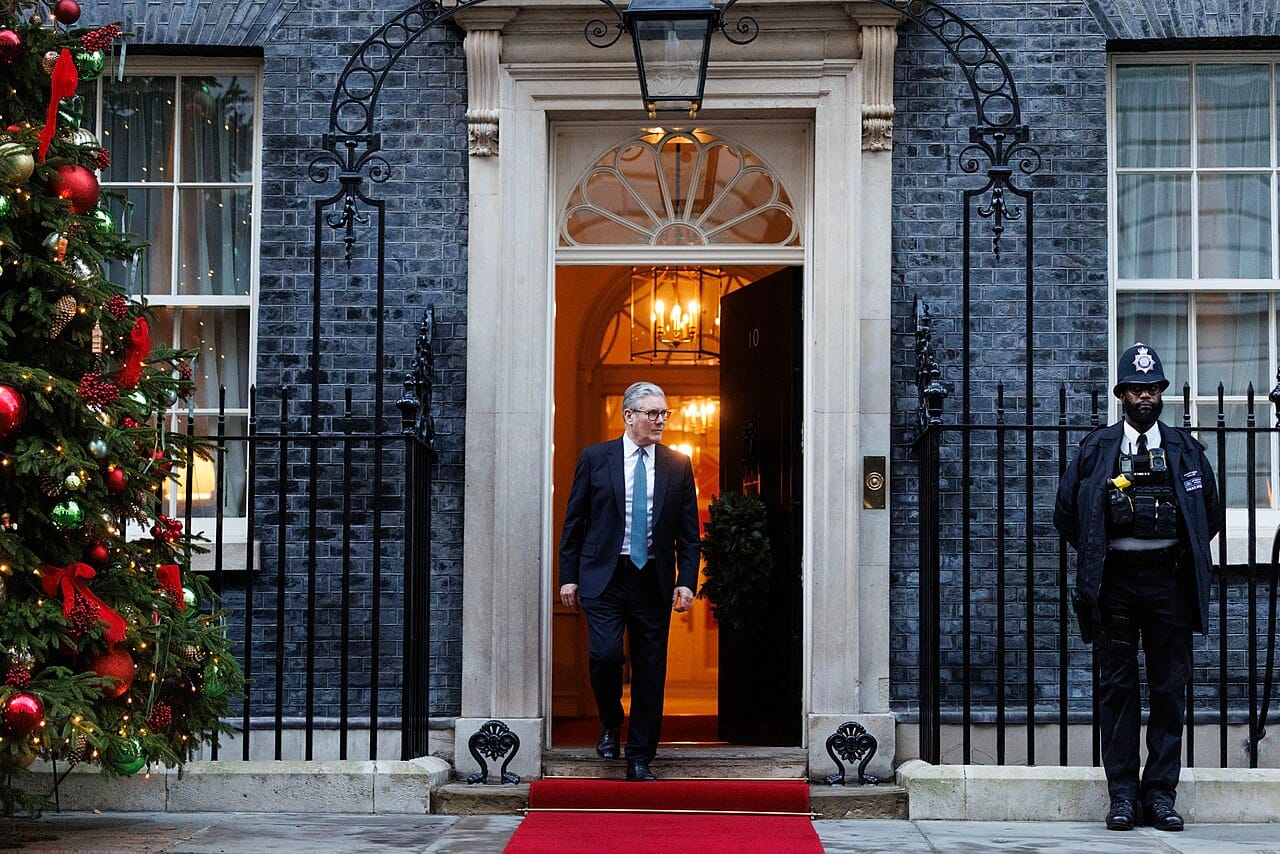
All the views and opinions expressed are those of the author. Image Credit: Simon Dawson/10 Downing Street.
About the Author
Jaiee Ashtekar holds a bachelor’s degree and a master’s degree in political science from the University of Mumbai. She holds a post-graduate diploma in international relations from the University of Strathclyde, United Kingdom (UK). She has done projects titled “Kashmir through Political Perception” and “Water issues between India and Pakistan.”