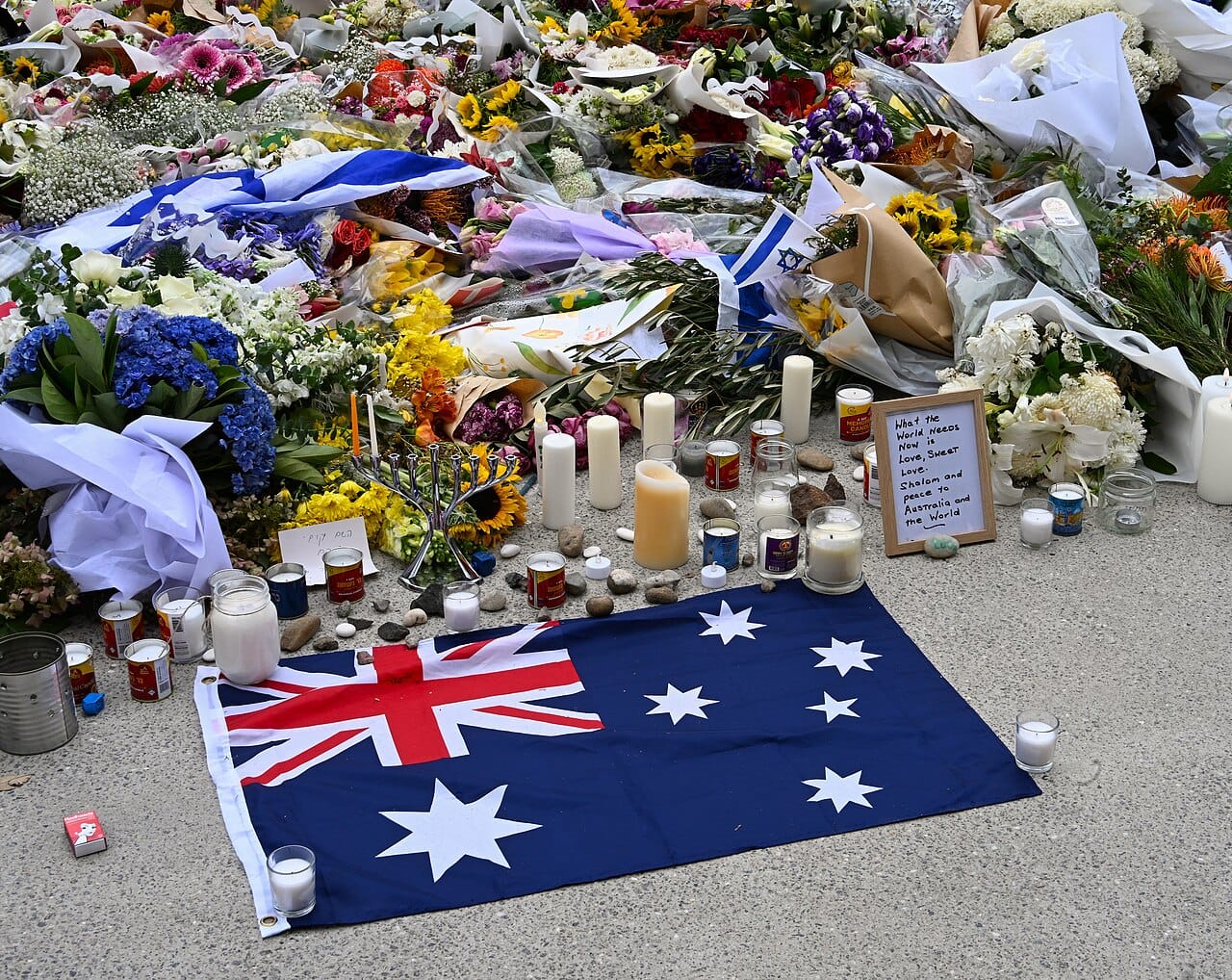
A place known for sun, surf, and carefree Australian summers was forever marked this week. On the evening of December 14, 2025, families gathered at Sydney’s Bondi Beach to celebrate the first night of Hanukkah. Suddenly, gunfire shattered the peaceful evening. In a brutal attack, two gunmen opened fire on a crowd of nearly a thousand people, turning a celebration into one of Australia’s darkest moments. Authorities have declared this a terrorist incident inspired by the Islamic State. The attack killed sixteen people, including a ten-year-old girl and an 87-year-old Holocaust survivor, and injured over forty more. Beyond the shocking numbers lies a deep national trauma that raises urgent questions about domestic security, rising hatred, and Australia’s role in an unstable world.
About the Attack
The attack was carefully planned and ruthlessly executed. The assailants, a 50-year-old father and his 24-year-old son, positioned themselves on a footbridge overlooking Archer Park, where a Chabad community event was taking place. Armed with rifles and shotguns, they fired over 100 rounds into the crowd below. The swift chaos of the violence was met with equal bravery. An unarmed bystander, identified as Ahmed Al Ahmed, tackled one of the shooters from behind, wrestled away his weapon, and likely saved many lives. Police arrived within minutes, confronted the gunmen, and neutralised the threat.
One attacker was killed at the scene, while the other was critically injured and taken into custody. Investigators uncovered a disturbing web of planning. Islamic State flags and improvised explosive devices were found in the attackers’ vehicle. Alarmingly, Australian police confirmed the father and son travelled to the Philippines in November. Intelligence suggested they were seeking military-style training in a region known for Islamist militant activity. Prime Minister Anthony Albanese stated the attack seemed motivated by Islamic State ideology. This marks it as Australia’s deadliest terror incident.
Rising Tide of Hate
To understand the shock of Bondi, one must consider its context. Bondi is not just a beach; it is at the centre of one of Australia’s largest Jewish communities. This attack is not an isolated incident but part of a troubling trend. Since the Gaza war began in October 2023, Australia has seen a significant increase in antisemitic rhetoric and attacks. In August 2024, the national terrorism threat level rose to “probable,” with security agencies citing community tensions linked to the conflict as a key factor. Moreover, the shadow of past violence looms large.
Just last year, in April 2024, the nearby Bondi Junction shopping centre was the scene of a deadly stabbing attack, a memory vividly recalled by survivors of Sunday’s shooting. Also etched in the national memory is the 1996 Port Arthur massacre, which took 35 lives and led to major gun reforms. The Bondi shooting is now the second-deadliest mass shooting in Australian history, a grim title that challenges the assumption that the laws from the Port Arthur tragedy had permanently shielded the country from such horrors. The revelation that the attackers legally acquired high-powered rifles despite these laws has sparked a fierce debate about regulatory gaps.
The international aspects of the attack are significant. The suspects’ journey to the Philippines highlights the ongoing, global nature of the Islamic State network, which can inspire and guide attackers far from its fading caliphate. This connects Bondi to a wider pattern of extremist violence aimed at religious and ethnic minorities. In response, world leaders have condemned the attack, and vigils have taken place from London to New York. At home, Australia finds itself at a challenging crossroads.
The government has promised a visible and ongoing investigation while hastening plans for further gun law reform. However, former Prime Minister John Howard, who was behind the 1996 reforms, argues that focusing solely on weapons is a distraction from the underlying issue of antisemitism. This tension between security measures and social unity shapes the way forward.
Muslim community leaders have strongly condemned the attack. Some even refused Islamic funeral rites for the shooters to separate their faith from this crime. Their stance, along with reports of retaliatory vandalism at a Muslim cemetery, highlights the risk of a dangerous cycle of blame between communities. The real test for Australia will be whether it responds with division or the united front seen in the courage of bystanders like Ahmed Al Ahmed and the shared solidarity at memorials.
Muslim community leaders have strongly condemned the attack. Some even refused Islamic funeral rites for the shooters to separate their faith from this crime. Their stance, along with reports of retaliatory vandalism at a Muslim cemetery, highlights the risk of a dangerous cycle of blame between communities. The real test for Australia will be whether it responds with division or the united front seen in the courage of bystanders like Ahmed Al Ahmed and the shared solidarity at memorials.
Ending Note
The Bondi Beach massacre represents a tragedy with many layers: a violent crime, a security failure, a sign of imported extremism, and a reflection of homegrown hatred. It has shaken Australia’s self-image as a safe, distant refuge from global conflicts. Moving ahead requires a dual commitment: relentless, intelligence-driven action to dismantle terrorist networks, and a bold, collective effort to challenge the antisemitic beliefs that fuel them. As Rabbi Eli Feldman said at a vigil by the beach, “There is only one way to stamp out darkness — with light.” For Australia and the world watching, restoring hope after the darkness of Bondi will be the defining challenge in the years to come.
References
- BBC News. (2025). Bondi Beach: Police investigating gunmen’s trip to Philippines month before shooting
- Australian Broadcasting Corporation (ABC). (2025). Bondi Beach shooting live updates: Police promise ‘highly visible, precise and around-the-clock’ investigation
- The Washington Post. (2025). Australia faces aftermath of Bondi Beach shooting as 25 remain hospitalized, including children
All the views and opinions expressed are those of the author. Image Credit: Sardaka | Wikimedia Commons.
About the Author
Jaiee Ashtekar holds a bachelor’s degree and a master’s degree in political science from the University of Mumbai. She holds a post-graduate diploma in international relations from the University of Strathclyde, United Kingdom (UK). She has done projects titled “Kashmir through Political Perception” and “Water issues between India and Pakistan.”